Prices checked August 2026. Confirm current offers and subscription terms at authorised TVS dealers.
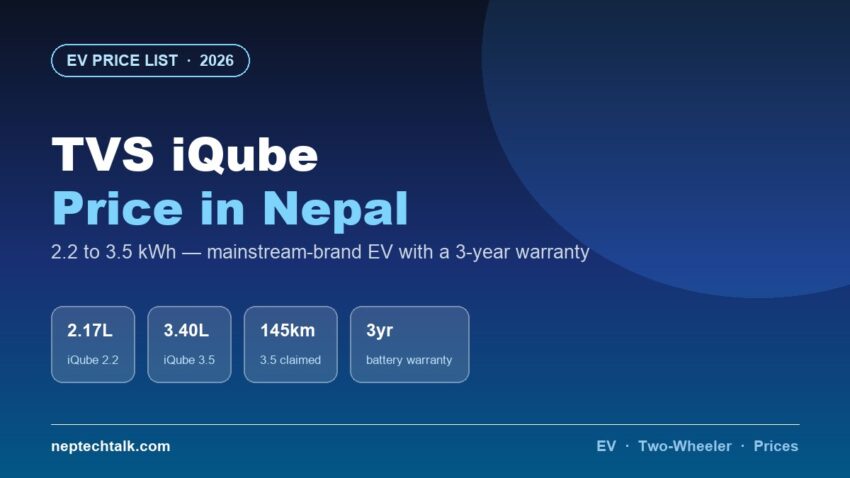
The iQube matters for a specific reason: it is an electric scooter from a mainstream motorcycle brand with an existing Nepali service network — which addresses the single biggest risk in EV two-wheeler ownership here. The TVS iQube price in Nepal spans NPR 2,17,000 to 3,39,900.
Current iQube prices
| Variant | Price (NPR) | Battery | Claimed range |
|---|---|---|---|
| iQube 2.2 | 2,17,000 | 2.2 kWh | 75 km |
| iQube 3.5 | 3,39,900 | 3.5 kWh | 145 km |
Warranty: 3 years or 50,000 km on the vehicle, and 3 years on the battery — among the stronger standard packages in the segment, matched only by Super Soco’s 3-year battery cover.
The Lifetime Battery Assurance offer: TVS has offered the iQube at NPR 2,99,900 with a Lifetime Battery Assurance programme, requiring a mandatory 3-year subscription plan. Read the subscription terms carefully before treating “lifetime” as free — get the annual cost, what it covers and what happens if you stop paying, in writing.
The variants, honestly
iQube 2.2 (NPR 2,17,000) — the value entry. At this price it undercuts the Yadea T9 (2,35,000) and Yadea G6 (2,60,000) while carrying TVS’s service network behind it. The 75 km claimed range means roughly 50 km of real-world planning — adequate for city commuting under 25 km daily, tight for anything more.
iQube 3.5 (NPR 3,39,900) — the usable one. The 145 km claim translates to roughly 90–100 km of realistic planning, which covers almost any Nepali city commute with margin. Against the NIU NQi Sport at 3,48,000, the iQube counters with TVS’s dealer depth; NIU answers with its app ecosystem.
Why the brand matters here
Nepal’s EV two-wheeler market is full of capable machines from brands with thin service networks — the recurring caution across our EV coverage. TVS is different: an established motorcycle brand with workshops across the country through Jagdamba Motors, the same network that services Apache and Raider owners.
That does not automatically mean every TVS workshop can service an EV — ask specifically whether your local dealer has EV-trained technicians and stocks controllers and battery modules. But the starting position is far stronger than a new-entrant badge.
The buying checks
- Which variant, exactly — the 2.2 and 3.5 differ enormously in usable range
- Subscription terms if taking the Lifetime Battery Assurance offer — annual cost, coverage, lapse consequences
- EV-trained technicians at your local workshop — confirm, don’t assume
- Charging time and home wiring — confirm the charger type and your meter’s capacity
- Registration category and insurance for your model, in writing
- Financing under NRB’s hire-purchase caps if not paying cash
Frequently asked questions
What is the TVS iQube price in Nepal? NPR 2,17,000 for the 2.2 kWh variant and NPR 3,39,900 for the 3.5 kWh, as of August 2026.
What is the real-world range? Plan on 60–70% of the claim: roughly 50 km for the 2.2 and 90–100 km for the 3.5, accounting for hills, pillion and speed.
Is the Lifetime Battery Assurance worth it? Potentially — but it requires a mandatory 3-year subscription. Get the annual cost, coverage scope and lapse terms in writing before deciding.
TVS iQube or Yadea? The iQube 2.2 undercuts the Yadea T9 and brings TVS’s service network. Yadea counters with global EV specialisation. For buyers who prioritise service access, the iQube’s brand infrastructure is the stronger argument.
Does it need bluebook registration? Yes, like other two-wheelers in its power class — confirm the category for your variant in writing at purchase.
The bottom line
The TVS iQube price in Nepal — 2.2 kWh at NPR 2,17,000, 3.5 kWh at 3,39,900 — brings a mainstream motorcycle brand’s service network to the EV segment, with a 3-year battery warranty behind it. Take the 3.5 if your commute exceeds 25 km daily, read the subscription terms if you take the assurance offer, and confirm your local workshop has EV-trained staff. Checked August 2026.