Checked August 2026. Wallet features, fees and limits change frequently — verify current terms in the apps.
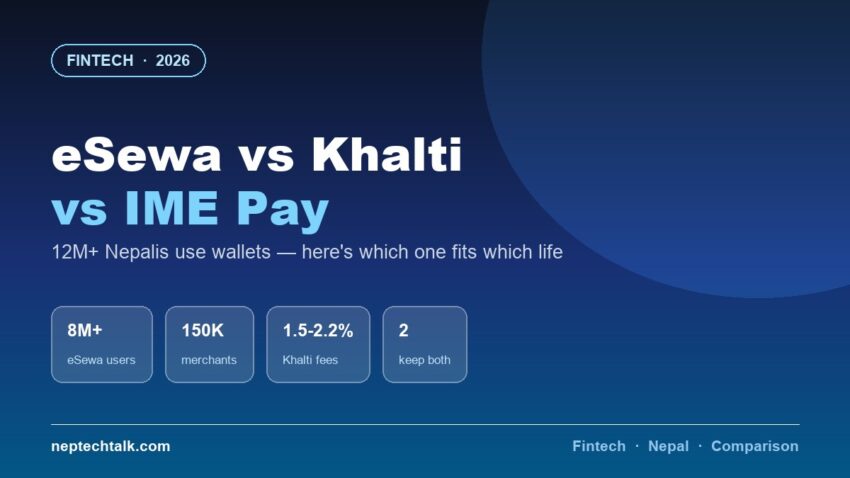
More than 12 million Nepalis now use digital wallets, and the market has consolidated into a clear structure. The eSewa vs Khalti question — with IME Pay now folded into Khalti — is genuinely worth thinking through, because the wallets have diverged in what they do best.
The current landscape
| eSewa | Khalti (with IME Pay) | |
|---|---|---|
| Users | 8+ million — Nepal’s largest | Rapidly growing challenger |
| Merchants | 150,000+ | Extensive and growing |
| Launched | The original | 2017 |
| Strength | Everyday bills, widest acceptance | Innovation, remittance, cross-border |
| Transaction fees | Varies by service | Generally 1.5%–2.2% per transaction |
| Recent change | — | Merged with IME Pay (Summit Group-backed) |
The IME Pay development matters: its integration into Khalti strengthens Khalti’s cross-border and remittance position — relevant for the large number of Nepali households receiving money from abroad.
Which to use for what
eSewa — the default for acceptance. With 8+ million users and 150,000+ merchants, eSewa is the wallet most likely to be accepted wherever you are. For utility bills, small-shop QR payments and sending money to people who probably already have it, eSewa’s network effect is the whole argument.
Khalti — the default for features and remittance. Post-merger, Khalti’s position in cross-border transactions is its distinguishing strength, alongside an interface many users find more modern. For NRN families and anyone whose money moves internationally, this matters.
The honest answer for most people: keep both. They are free, they take minutes to set up, and merchant acceptance still varies shop to shop. This mirrors the dual-SIM logic that most Nepalis have already worked out for mobile networks.
What actually decides your primary wallet
- Where you spend. Check which QR your regular shops, restaurants and utility providers accept. That answer beats any feature comparison.
- Your bank’s integration. Load and withdrawal convenience varies by bank; whichever links most smoothly to your account should be your primary.
- Cashback and offers. Both run promotions aggressively — the offers rotate, so neither wins permanently. Check both apps before large payments.
- Remittance needs. If money comes from abroad regularly, Khalti’s post-merger position deserves the closer look.
- Transaction fees. Compare on the services you actually use — fees differ by transaction type, not just by wallet.
Safety practices that matter
Digital wallets in Nepal are targeted by social-engineering scams constantly. The non-negotiables:
- Never share your OTP. No legitimate representative of any wallet, bank or company will ask for it.
- Never install screen-sharing apps at a caller’s request — this is the single most common wallet-emptying scam in Nepal.
- Enable app lock / biometric in the wallet’s settings.
- Verify recipient details before confirming a transfer; wallet transfers are effectively irreversible.
- Do not store large balances — wallets are for transacting, banks are for holding.
Frequently asked questions
Which is better, eSewa or Khalti? eSewa for acceptance breadth (8+ million users, 150,000+ merchants); Khalti for features and remittance, especially post-IME merger. Most people benefit from having both.
What happened to IME Pay? IME Pay has merged into Khalti, strengthening Khalti’s remittance and cross-border capability.
What are the transaction fees? Khalti’s fees generally range from about 1.5% to 2.2% per transaction depending on service; eSewa’s vary by transaction type. Compare on the services you actually use.
Is it safe to keep money in a digital wallet? Use wallets for transacting, not for holding savings. Keep balances modest, enable app lock, and never share OTPs.
Can I send money abroad with these wallets? Cross-border capability is Khalti’s strengthened area post-merger. Confirm current supported corridors and limits in the app.
The bottom line
eSewa vs Khalti in Nepal: eSewa wins acceptance, Khalti wins features and remittance after absorbing IME Pay. Install both — they cost nothing, and merchant acceptance still varies. Then protect them properly: no OTP sharing, no screen-sharing apps, no large balances. Checked August 2026.