Updated August 2026
Walk into any mobile shop in Nepal with a NPR 25,000–45,000 budget and you will face the same fork: a Galaxy A-series vs M-series decision, often between two phones that look nearly identical on the spec sheet. The lines exist for different reasons, and knowing the reason tells you which to buy.
The one-paragraph answer
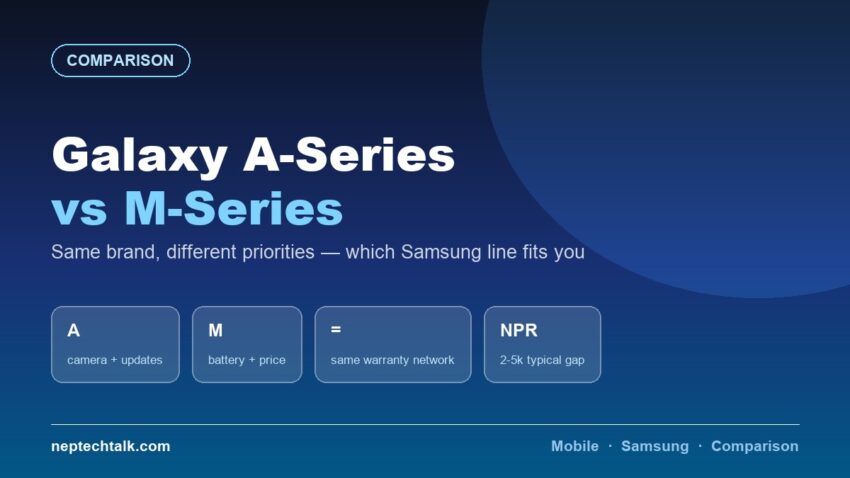
The A-series is Samsung’s main retail line: better cameras at the same tier, longer and faster software updates, and the version Samsung showcases in stores. The M-series is the value line: bigger batteries and lower prices, achieved by trimming camera hardware, build touches and update priority. In Nepal both carry the same official warranty through the same service network — so the decision is purely about what you value, not about support.
Where the lines actually differ
| Galaxy A-series | Galaxy M-series | |
|---|---|---|
| Positioning | Mainstream retail | Value / online-first |
| Cameras | Better sensors, OIS appears earlier | Adequate, rarely OIS at the same price |
| Software updates | Longer promise, earlier delivery | Shorter promise, later delivery |
| Battery | Standard (5,000mAh typical) | Often larger (6,000mAh on some models) |
| Build | Slightly nicer materials and finish | Function over form |
| Price at same tier | Baseline | Usually NPR 2,000–5,000 less |
| Warranty in Nepal | Official, same network | Official, same network |
When the M-series is the right call
You charge once a day, reluctantly. M-series models with 6,000mAh batteries genuinely deliver the extra half-day the spec implies. For field work, load-shedding-prone areas or long bus routes, this is the practical difference.
Your budget is fixed and the M gets you a tier higher. The M-series’ discount sometimes buys the next chipset up. A better processor on an M beats a prettier camera on an A for gaming and longevity.
The phone is a tool, not a camera. Calls, banking apps, YouTube, TikTok viewing — the M does all of it identically.
When to pay the A-series premium
You photograph anything that matters — children, products for your shop, documents. OIS and the better sensors show up exactly where budget cameras fail: evening light, indoor shops, moving subjects.
You keep phones four-plus years. The A-series’ longer update commitment is real money: a phone that stops getting security patches becomes a banking-app risk in Nepal, where mobile banking is now the default.
Resale matters. A-series units are better known and hold value better in the second-hand market here.
The Nepal-specific note
Both lines are officially imported and serviced. The thing to actually verify is not A-vs-M — it is official vs grey. A grey-market A-series phone is a worse buy than an official M-series phone every time: no warranty, and MDMS registration risk. Check the IMEI (\*#06#) against the MDMS registry before buying from anywhere that is not a brand store.
Current confirmed pricing for the models both lines compete around is in our Samsung mobile price in Nepal list, updated monthly.
Frequently asked questions
Is the M-series lower quality than the A-series? No — it is the same company, same warranty, different priorities. The M trades camera and finish for battery and price. Nothing about it is inferior in reliability.
Do M-series phones get Android updates in Nepal? Yes, but typically fewer major versions and later than the equivalent A-series. If updates matter to you, that is the A-series’ strongest card.
Which holds resale value better in Nepal? The A-series, consistently. It is the better-known line, and second-hand buyers pay for familiarity.
Is there an M-series phone with no A-series equivalent? The big-battery M models (6,000mAh) have no direct A-series twin — if that battery is why you are buying, the M-series is not a compromise, it is the only option.
The bottom line
Buy the A-series for cameras, updates and resale; buy the M-series for battery and price. In Nepal the warranty and service question — usually the tiebreaker between brands — is a tie here, so let your actual usage decide. And whichever you choose, buy the official unit.