Updated August 2026
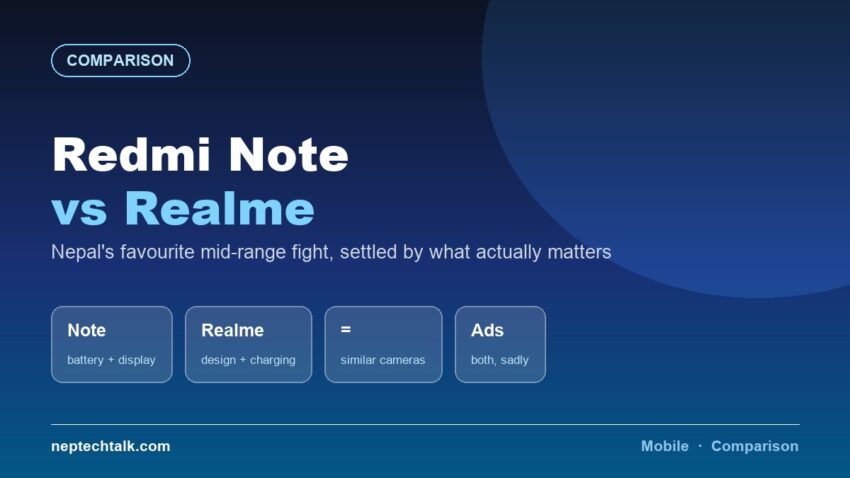
Between NPR 30,000 and 70,000, two lines dominate Nepali shop counters: the Redmi Note vs Realme number-series rivalry. They chase the same buyer with the same pitch — flagship-adjacent specs at mid-range money — which is exactly why choosing between them confuses everyone. Here is the honest separation.
The one-table verdict
| Redmi Note series | Realme number series | |
|---|---|---|
| Displays | Consistently excellent AMOLEDs | Excellent, slightly behind at same price |
| Battery | Larger (6,000mAh+ appearing) | Good, smaller typically |
| Charging | Fast | Often faster — Realme’s signature |
| Cameras | Solid, tuning conservative | Solid, tuning punchy |
| Software | MIUI-lineage: feature-rich, ad-prone | Realme UI: lighter feel, ad-prone |
| Ingress rating | Leading (IP68/69 on recent Notes) | Improving, behind |
| Service in Nepal | Wide authorised network | Decent, thinner outside cities |
| Resale | Stronger — better-known line | Softer |
Where Redmi Note wins
Durability spec. Recent Notes carry serious ingress ratings — meaningful in a country with a real monsoon. A phone that shrugs off rain is worth real money here.
Battery capacity. The Note line’s newer silicon-carbide batteries (6,500mAh on the Note 15 Pro+, priced at NPR 63,999 — see our Xiaomi price list) simply outlast the equivalent Realme.
Resale and familiarity. “Redmi Note” is practically a category name in Nepal; the second-hand market pays for that recognition.
Where Realme wins
Charging speed. Realme routinely ships the fastest charging at each price point — full charges in half an hour on some models. If your day has no charging window, this is a genuine daily-life advantage.
Design weight. Realme’s number series tends slimmer and lighter at the same battery class, and its finishes photograph better than they cost.
Aggressive launch pricing. Realme frequently undercuts the equivalent Note at launch in Nepal by a couple of thousand — the gap Redmi closes later with campaign pricing.
The shared weaknesses
Both ship software with promotional content and preinstalled apps you will spend the first evening removing (our de-bloating guide covers the cleanup). Both promise fewer OS updates than Samsung at the same price. And both suffer heavy grey-market circulation in Nepal — the official-unit check (IMEI on MDMS, warranty on the bill) matters equally for either badge.
So which do you buy?
- Default: Redmi Note — battery, ingress rating and resale carry more long-term weight than charging speed.
- Pick Realme if ultra-fast charging or in-hand feel decides for you, or its launch discount opens a spec gap at your exact budget.
- Pick neither if you keep phones five-plus years — a Galaxy A-series’ longer updates serve that better, as we covered in the A-series vs M-series guide.
Frequently asked questions
Redmi Note or Realme — which has better cameras? Same class. Redmi tunes natural, Realme tunes vivid; neither wins outright. Judge the specific model pair, not the badge.
Which brand has better service in Nepal? Xiaomi’s authorised network reaches further outside major cities. In Kathmandu or Pokhara, both serve fine.
Which lasts longer? Hardware: comparable. Software: comparable. The Note’s bigger batteries age more gracefully — more capacity to lose before it hurts.
Are these phones good for gaming? Upper models of both handle PUBG/Free Fire at respectable settings. For dedicated gaming at this money, the Poco performance line (same group as Redmi) is the sharper tool.
The bottom line
In the Redmi Note vs Realme fight, buy the Note by default for battery, durability rating and resale; buy the Realme when charging speed or launch pricing tilts your specific budget. Either way, buy official — the badge matters less than the bill in Nepal’s mid-range.