Checked August 2026. ISP pricing and packages change — verify current plans before committing to a year.
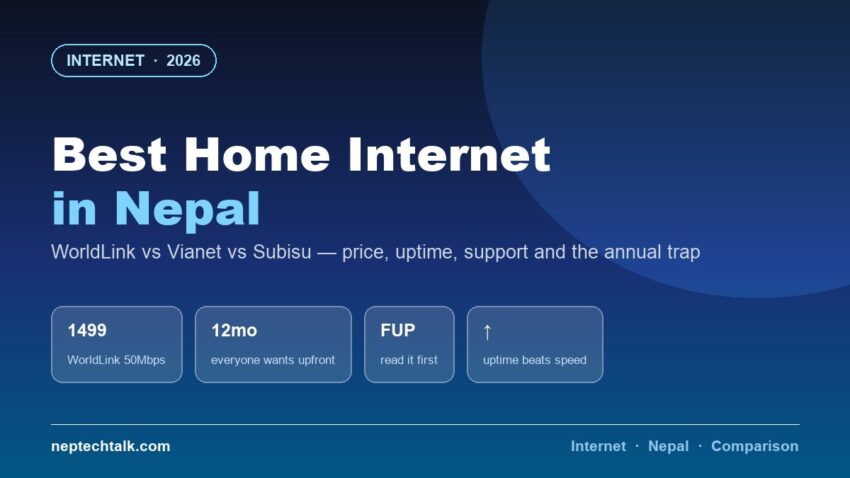
Choosing home internet in Nepal is a bigger decision than choosing a phone, because almost every ISP wants twelve months paid upfront. Getting the best internet in Nepal for your address means judging four things — and speed is the least important of them.
The contenders
| ISP | Reputation | Notable |
|---|---|---|
| WorldLink | Largest, widest coverage, strong support | 50 Mbps around NPR 1,499/month; plans to 1 Gbps |
| Vianet | Competitive pricing, solid urban performance | Diverse plans across user types |
| Subisu | Affordability plus TV bundles | Basic Plus TV around NPR 3,938/3 months, 5,221/12 months |
| ClassicTech / others | Regional strength | Worth quoting where present |
The four things that actually decide it
1. Coverage at your exact address — not your area. Fibre availability changes street to street in Nepal. Before comparing anything else, call all three and ask about your building. The best-value plan you cannot get installed is worth nothing.
2. Uptime and support response, not headline speed. For a household, the gap between 50 and 100 Mbps is invisible; the gap between four-hour and four-day fault resolution is everything. Ask neighbours on each ISP how long their last outage took to fix — this single question outperforms every review.
3. FUP and fine print. “Unlimited” plans in Nepal often carry fair-usage thresholds after which speed drops. Ask for the FUP number in writing, and match it against your household’s real consumption.
4. The annual-payment structure. Nearly all Nepali ISPs require 12 months upfront; some offer quarterly at a higher effective rate. This means an ISP mistake costs you a year — which is exactly why questions 1–3 matter more than a NPR 200 monthly difference.
Rough decision guide
- Widest coverage and best support track record: WorldLink, which is why it commands the market — and prices accordingly.
- Best value where available: Vianet frequently undercuts on comparable speeds; verify local uptime reputation first.
- TV bundle households: Subisu’s combined internet+IPTV packages can beat buying both separately — price the bundle against your actual TV usage, not the channel count.
- Regional providers: in some towns, a local ISP delivers better response times than a national brand. Ask neighbours.
Mobile data vs home internet
If your household uses under ~40 GB monthly, mobile data packs can still compete. Above that, fibre wins decisively on rupees-per-GB — and removes the rationing anxiety entirely. Our data pack comparison has the crossover maths.
Frequently asked questions
Which is the best internet service provider in Nepal? WorldLink leads on coverage and support scale; Vianet on price where available; Subisu on TV bundles. Your address and your neighbours’ outage experiences decide better than any national ranking.
How much does home internet cost in Nepal? Entry fibre plans start around NPR 1,499/month equivalent for 50 Mbps class, with most households landing between NPR 1,500 and 2,500 monthly when annual payments are amortised.
Do I have to pay a year in advance? Almost always, yes — most ISPs require 12 months upfront, with quarterly options at higher effective rates. Budget for it and choose carefully.
What speed do I actually need? For a family streaming and working: 50–100 Mbps is ample. Beyond that, you are buying headroom, not experience — spend the difference on a better router instead.
Can I switch ISPs mid-contract? Rarely without losing the prepaid balance. This is why the address-and-uptime homework comes before the price comparison.
The bottom line
The best home internet in Nepal is the one that works at your address and gets fixed fastest when it breaks — WorldLink for coverage and support, Vianet for value, Subisu for TV bundles. Ask your neighbours, get the FUP in writing, and remember you are choosing for a full year. Checked August 2026.