Checked August 2026. ISP plans change frequently — verify current pricing before committing to a year.
Nepali ISPs quote monthly figures for products sold annually, with taxes and equipment charges arriving later. Understanding the real internet price in Nepal means reconstructing the total before you sign — here is how the numbers actually work.
The speed tiers and rough monthly equivalents
| Speed tier | Typical monthly equivalent (NPR) | Who needs it |
|---|---|---|
| 25–35 Mbps | ~1,200–1,400 | One or two people, light use |
| 50 Mbps | ~1,499 and up | The mainstream family plan |
| 100–150 Mbps | ~1,800–2,500 | Multi-device homes, WFH, streaming |
| 200–500 Mbps | ~2,500–4,000 | Heavy households, small offices |
| 1 Gbps | premium tiers | Enthusiast/business |
WorldLink’s 50 Mbps at around NPR 1,499/month is the market’s reference point; competitors position around it. Subisu’s TV bundles price differently — for example, a Basic Plus TV package at roughly NPR 3,938 for three months or 5,221 for twelve blends internet and IPTV.
The charges the monthly figure hides
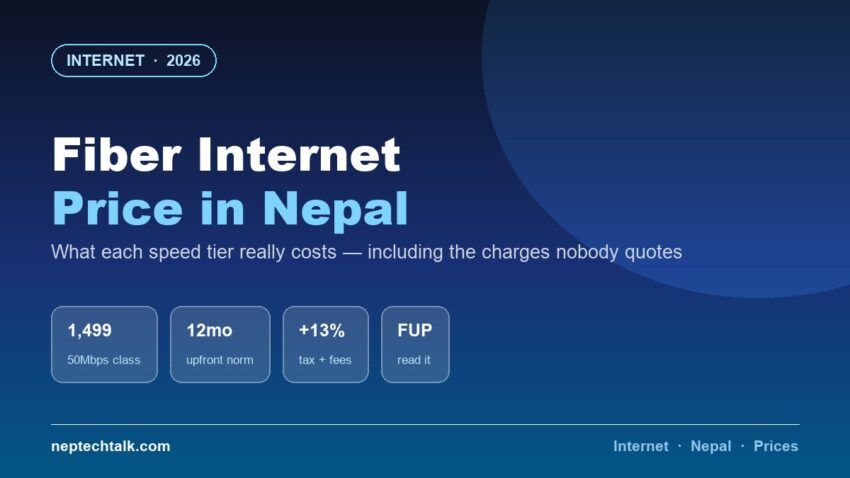
- Annual prepayment. Almost every ISP wants 12 months upfront. Quarterly options exist at higher effective rates. Your “NPR 1,499/month” plan is really an NPR 18,000-ish decision.
- Taxes and service charges are frequently quoted separately — ask for the total payable figure, not the plan price.
- Router and installation — sometimes free on annual plans, sometimes a deposit, sometimes a purchase. Get it specified.
- FUP thresholds — “unlimited” often means full speed until X GB. Ask for the number in writing.
- Static IP, extra ONU, IPTV add-ons — priced individually.
How to actually choose
Speed is the least important variable. In order:
- Availability at your exact address — call all providers; fibre coverage varies street to street.
- Local uptime and support response — ask neighbours how long their last outage lasted. Nothing on a website tells you this.
- Total 12-month payable, all-in.
- FUP and fair-use terms.
- Speed — 50–100 Mbps satisfies almost every household; beyond that you buy headroom.
Our ISP comparison covers the WorldLink/Vianet/Subisu character differences in more detail.
Fibre vs mobile data
Below roughly 40 GB monthly, mobile data packs remain competitive and avoid the annual lock-in. Above it, fibre wins decisively per GB. Households with heavy streaming or work-from-home should not be rationing mobile data — the maths stopped favouring it long ago.
Frequently asked questions
How much does fiber internet cost in Nepal? Mainstream 50 Mbps plans sit around NPR 1,499/month equivalent, with most households paying NPR 1,500–2,500 monthly once the annual payment is amortised — before taxes and equipment.
Why do ISPs demand a year upfront? It is the market norm in Nepal, tied to installation costs and churn. Quarterly options exist at worse rates; monthly is rare.
Which ISP is cheapest? It varies by address and campaign. Vianet frequently undercuts on comparable speeds; WorldLink prices for coverage and support. Get quotes from all providers serving your building.
Do I need more than 100 Mbps? Almost certainly not for a household. Spend the difference on a better router — a weak router bottlenecks a fast plan routinely.
Can I get my money back if service is bad? Refund terms vary and are rarely generous. This is exactly why the address-and-neighbours homework precedes the payment.
The bottom line
The fiber internet price in Nepal is a yearly decision dressed as a monthly one. Reconstruct the total payable, get the FUP in writing, ask neighbours about outages, and buy 50–100 Mbps from whichever provider actually serves your address well. Speed is the easy part; support is the purchase. Checked August 2026.