Checked August 2026. Budget wearable pricing swings with campaigns.
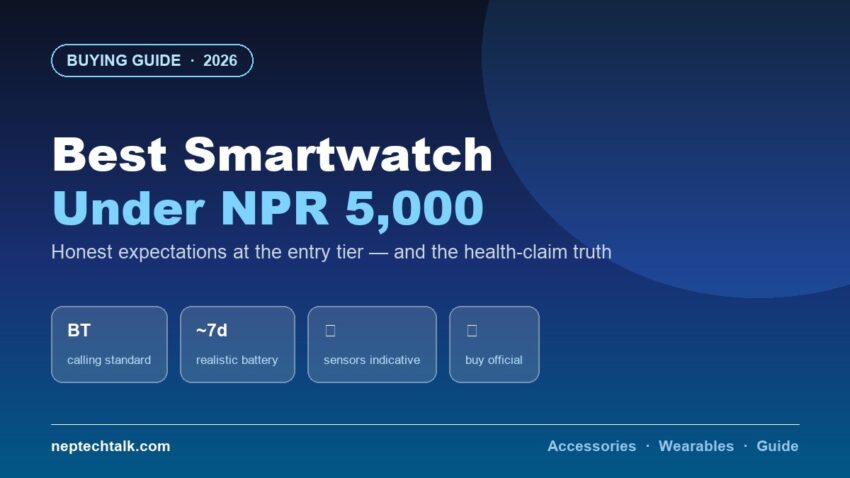
Under NPR 5,000 is where most Nepalis buy their first smartwatch, and the category rewards correctly calibrated expectations more than careful model selection. The best smartwatch under 5,000 in Nepal is a genuinely useful notification-and-fitness device with clear limits.
What this budget delivers
| Feature | Reality |
|---|---|
| Notifications | Works well — the main daily value |
| Bluetooth calling | Standard at this price |
| Step and sleep tracking | Directionally useful |
| Heart rate | Reasonable at rest, less so during exercise |
| SpO2 / BP-style features | Entertainment, not measurement |
| Battery | 5–10 days claimed; expect roughly half in real use |
| Build | Plastic, 1–2 year realistic lifespan |
| Water resistance | Splash-resistant at best |
The brands
Noise — entry models from about NPR 3,000, huge design variety, Bluetooth calling standard.
Fire-Boltt — same segment, typically the largest screens per rupee.
Amazfit Bip class — sits at the top of this band or just above, and delivers meaningfully better software, sensors and genuine multi-week battery. If your budget reaches NPR 5,000–6,000, this is where it should go.
Phone-brand budget bands — Redmi Watch, Realme Band and similar are legitimate options, often discounted alongside phone purchases.
The honest recommendation
Stretch to the Amazfit Bip tier if you can. The difference between a NPR 3,500 Noise/Fire-Boltt and a NPR 6,000 Amazfit is not marginal — it is better sensors, dramatically more honest battery life, stabler software and longer support.
If NPR 5,000 is genuinely the ceiling, Noise and Fire-Boltt do the job. Buy on design preference and the week’s price; they are close enough that model-by-model comparison is not worth your time.
The health-claim reality check
This deserves emphasis because the marketing is aggressive:
Budget smartwatches are not medical devices. SpO2 readings, “blood pressure” features and stress scores at this price are estimates produced by inexpensive sensors and software.
What they are genuinely good for: noticing that you walked less this week than last, that your sleep is shorter than you thought, that your resting heart rate has changed over months. Trends, not numbers.
What they must not be used for: any health decision. If you have a medical concern, see a doctor — not your wrist.
The counterfeit warning
Budget wearables are heavily counterfeited in Nepal. Buy from authorised sellers or official online stores, scan the box code, and insist on a bill with warranty. At this price a fake dies within months and erases the entire saving.
Frequently asked questions
What is the best smartwatch under NPR 5,000 in Nepal? Noise and Fire-Boltt entry models within budget; the Amazfit Bip tier if you can stretch slightly — it is a meaningfully better device.
Are the health readings accurate? Steps and sleep are directionally useful. SpO2 and blood-pressure-style features are not reliable at any budget price, on any brand.
How long does the battery actually last? Roughly half the marketed claim in real use with always-on display and Bluetooth calling enabled.
Do they work with iPhone? Basic notifications yes, full functionality varies. Apple Watch is the iPhone answer, and it costs far more.
Is Bluetooth calling useful? Genuinely — for short calls when your phone is in a bag or pocket. Audio quality is modest.
The bottom line
The best smartwatch under NPR 5,000 in Nepal is a Noise or Fire-Boltt entry model — or better, an Amazfit Bip if your budget stretches a little. Calibrate expectations to notifications, step counts and sleep trends, treat every health number as indicative, buy official, and you will get real daily value from a very small amount of money.