Updated August 2026
Charging wattage is now a headline specification on every Nepali phone box, and the numbers are genuinely confusing. Here is fast charging explained — what each tier actually delivers, what it costs in battery health, and how much to pay for.
What the watts mean in practice
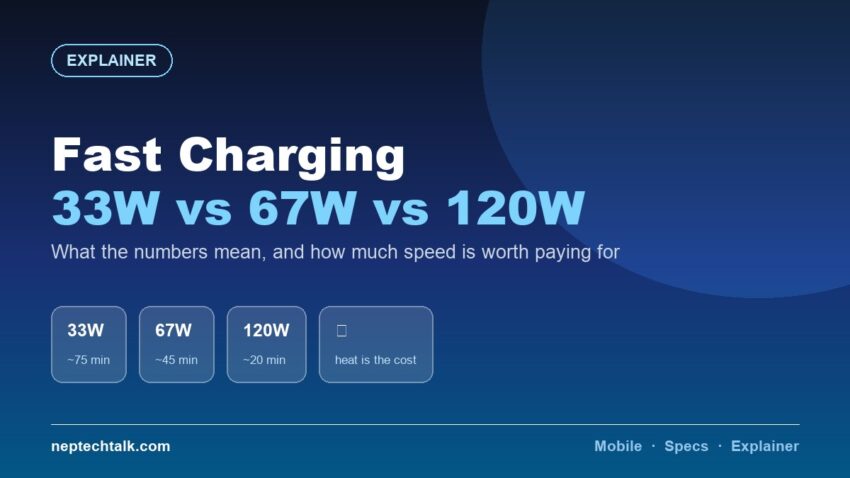
| Wattage | Realistic 0–100% | 30-minute top-up | Common at |
|---|---|---|---|
| 15–18W | 2–2.5 hours | ~30% | Under NPR 15,000 |
| 33W | 70–80 minutes | ~55% | NPR 20,000–30,000 |
| 45–67W | 40–55 minutes | ~75% | NPR 30,000–60,000 |
| 80–120W | 20–30 minutes | ~90%+ | Upper mid and flagship |
The important nuance: wattage is peak, not sustained. A “120W” phone runs at 120W for a few minutes at low charge, then steps down substantially as the battery fills and heats. The 0–50% figure is where fast charging genuinely shines; 80–100% is slow on every phone by design.
Does fast charging damage the battery?
Modestly, through heat — which our battery health guide identifies as the primary degradation factor.
But modern phones manage this actively:
- Charging speed is throttled as temperature rises
- Battery chemistry and cooling are designed around the rated speed
- Many phones offer adaptive charging that slows overnight charging deliberately
The practical position: fast charging on a phone designed for it is fine. What genuinely harms batteries is heat from other sources — direct sun, gaming while charging, hot rooms.
The habit that matters: use fast charging when you need speed, slower charging when you have time. Overnight, enable adaptive charging.
How much should you pay for charging speed?
The honest assessment:
The jump from 18W to 33W is transformative. Waiting two hours versus 75 minutes changes daily life. This is worth paying for.
The jump from 33W to 67W is genuinely useful. A 15-minute top-up giving you most of a day is a different relationship with your charger.
The jump from 67W to 120W is marginal for most people. Saving 20 minutes on a full charge matters if you charge in short bursts between commitments; it is a rounding error if you charge overnight.
Do not sacrifice camera, battery capacity or chipset for charging wattage. Realme leads the market on charging speed, but as our buying guides consistently note, that should be a tie-breaker rather than a primary reason.
The Nepal-specific angle
Charging speed matters more here than in some markets:
- Load-shedding and power interruptions — a phone that charges to 60% in 20 minutes is genuinely valuable when power availability is uncertain
- Long commutes and travel — a quick top-up before leaving beats planning around a two-hour charge
- Shared charging points in offices, shops and homes
The charger caveat — this matters
You only get the rated speed with the correct charger and cable.
- The in-box charger (where included) delivers the rated speed
- A different brand’s charger usually falls back to a slower standard
- Fake chargers are a genuine hazard — the counterfeit accessory market in Nepal is substantial. Our charger guidance covers verification.
- Cheap cables limit current regardless of the charger
If your phone charges slowly, check the cable before blaming the phone.
Frequently asked questions
Is 120W charging worth it? For most people, no — the jump from 33W to 67W delivers most of the benefit. Do not compromise other specifications for peak wattage.
Does fast charging reduce battery lifespan? Slightly, through heat. Modern phones manage it well. Heat from sun and gaming while charging does far more damage.
Can I use any charger? Physically yes, but you will get slower speeds without the matching charger and cable. Never use counterfeit chargers.
Why does my phone charge slower after 80%? By design — charging slows near full to protect the battery. Every phone does this.
Does wireless charging harm the battery? It generates more heat than wired charging at equivalent speeds. Convenient; slightly harder on the battery.
The bottom line
Fast charging explained simply: 33W transforms the experience over 18W, 67W is genuinely useful, and 120W is a marginal gain for most people. Use fast charging when you need it, slower charging overnight with adaptive mode on, and never use a counterfeit charger. And never choose a phone on wattage alone — it should break ties, not decide them.