Checked August 2026. Confirm prices and variants at the dealership.
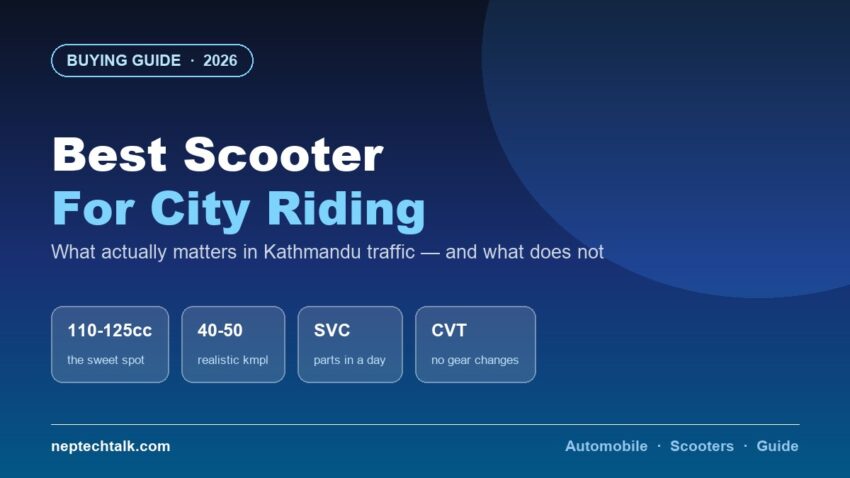
For daily commuting in Kathmandu, Pokhara or any Nepali city, a scooter beats a motorcycle on almost every practical measure. The best scooter in Nepal for city use is decided by four things — and engine capacity is not the most important of them.
What actually matters in city riding
| Priority | Factor | Why it matters here |
|---|---|---|
| 1 | Service network and parts | Breakdowns must be a one-day problem, not a one-week one |
| 2 | Real mileage | You will do this every day for years |
| 3 | Seat height and weight | Stop-start traffic means constant foot-down balancing |
| 4 | Under-seat storage | A helmet that lives in the scooter is a helmet you wear |
| 5 | Suspension quality | Nepali city roads are not smooth |
Engine capacity barely registers. In city traffic you rarely exceed 40 km/h. A 110cc and a 160cc scooter feel almost identical in a Kathmandu jam; the larger engine simply costs more to buy and run.
The capacity question, settled
110–125cc is the correct answer for city commuting.
- Below 110cc — struggles with a pillion on Kathmandu’s inclines
- 110–125cc — comfortable solo and with a pillion, best mileage, lowest running cost
- 150cc and above — meaningful only if you regularly ride highways or carry two adults up steep gradients
Anyone recommending a large-capacity scooter for pure city commuting is selling, not advising.
Realistic mileage
Expect 40–50 kmpl in real city riding, against claimed figures of 55–65 kmpl.
City conditions — constant stopping, idling in traffic, short trips where the engine never fully warms — cost fuel efficiency everywhere. What genuinely helps:
- Correct tyre pressure, checked fortnightly. The single cheapest mileage improvement available.
- Regular servicing at the recommended interval
- Smooth throttle — hard acceleration between traffic lights is where mileage disappears
- Not idling at long stops
The service network rule
Buy the brand whose service centre is nearest to you.
For a vehicle you depend on daily, the difference between a workshop 2 km away with parts in stock and one 15 km away that orders parts from Kathmandu is enormous. In practice this means the established Nepali brands with dense dealer networks, unless you live somewhere a newer brand has genuine local presence.
Ask specifically: does the nearest workshop stock common wear parts, or order them?
Should you consider electric?
Genuinely, yes — for pure city commuting, an electric scooter makes a strong case. Running costs are dramatically lower, city speeds suit the range comfortably, and maintenance is minimal.
The trade-offs: higher purchase price, charging arrangements, thinner service networks, and battery replacement cost in the long term. Our EV scooter guide and running-cost analysis cover the decision properly.
A fair summary: if you have home charging and a service centre nearby, electric is now the better city commuter. If either is missing, petrol remains the sensible default.
Buying checks
- Test ride with your normal load — including a pillion if you carry one
- Sit on it flat-footed — seat height matters more than any specification
- Open the under-seat storage with your actual helmet
- Confirm the nearest service centre address and parts availability
- Check the finance terms in writing if buying on EMI — see hire purchase rules
- Insurance quote before purchase
- Bluebook and registration timeline from the dealer
Frequently asked questions
What is the best scooter in Nepal for city riding? A 110–125cc scooter from a brand with a service centre near you. Service reach matters more than the badge.
How much mileage will I actually get? Around 40–50 kmpl in city conditions, against claimed 55–65 kmpl.
Is 110cc enough for two people? For city riding, yes. On steep gradients with two adults, 125cc is more comfortable.
Scooter or motorcycle for the city? Scooter, clearly — no gear changes in traffic, under-seat storage, easier for shorter riders.
Should I buy electric instead? If you have home charging and nearby service, yes. Otherwise petrol remains simpler.
The bottom line
The best scooter in Nepal for daily city riding is a 110–125cc machine from whichever brand services your area properly. Ignore engine-capacity marketing, expect 40–50 kmpl, and sit on it before you buy — seat height and storage will affect your daily life far more than any number on the brochure.