Updated August 2026
Nepal’s monsoon runs for months, and phones die in it every year. The IP rating on the box is supposed to tell you whether yours will survive — but almost nobody reads it correctly. Here is IP rating explained, and what it genuinely means for a Nepali monsoon.
What the two digits mean
IP followed by two numbers: the first is dust, the second is water.
| Rating | Dust | Water | Real meaning |
|---|---|---|---|
| IP52 / IP54 | Limited / protected | Drips / splashes | Survives light rain, nothing more |
| IP53 | Protected | Spray | Light rain from above |
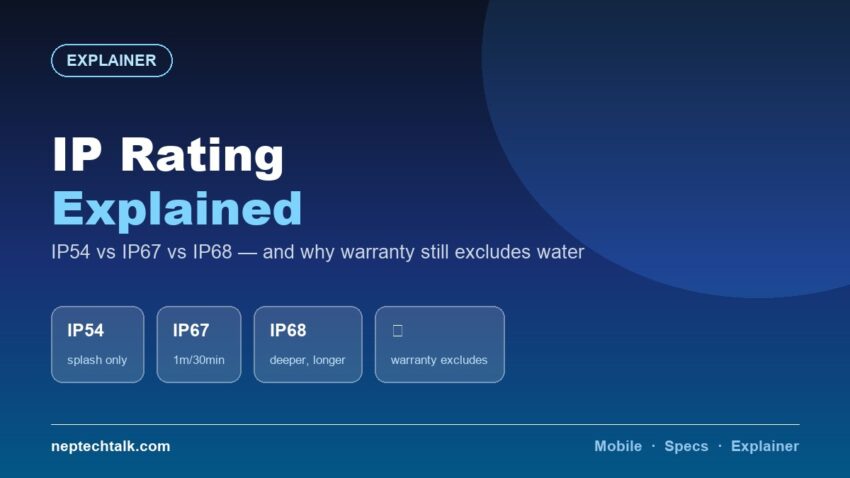
| IP67 | Dust-tight | 1 metre, 30 minutes | Survives immersion briefly |
| IP68 | Dust-tight | Beyond 1 metre, longer | The strongest common rating |
| No rating | — | — | Assume no protection at all |
The first digit maxes at 6 (dust-tight). So IP67 and IP68 are equally dust-proof; only the water figure differs.
The three things nobody tells you
1. IP68 does not mean waterproof. It means water-resistant, under specific laboratory conditions: fresh, still water, at a defined depth and duration, on a new device. That is not monsoon rain driven sideways at a bike rider.
2. The rating degrades over time. Seals age. Drops flex the frame. Repairs — especially screen or battery replacement — frequently break the seal permanently. A two-year-old IP68 phone is not IP68 any more, and no manufacturer claims otherwise.
3. Water damage is excluded from almost every warranty, at every rating. This is the point that surprises people most. Manufacturers advertise IP68 and then decline water-damage claims, because the rating describes a test condition, not a guarantee. Most phones contain a liquid contact indicator that turns colour, and service centres check it.
Read that again before you trust a rating in the rain.
What each rating means for a Nepali monsoon
No rating or IP52 — keep it in a sealed bag. A single heavy downpour can kill it.
IP53 / IP54 — survives being caught in rain briefly. Does not survive a sustained soaking, and does not survive being dropped in water.
IP67 — genuinely useful. Handles heavy rain, an accidental drop in a puddle, and washing off mud. This is the practical threshold where you stop worrying day to day.
IP68 — the same practical benefit as IP67 for real use, with more margin.
The honest guidance: IP67 is where a Nepali monsoon stops being a threat. Below that, take precautions. Above it, the difference is mostly marketing.
Practical monsoon protection
Regardless of rating:
- Dry the charging port completely before charging. Charging a wet USB-C port is the most common way phones die in monsoon — and it is entirely avoidable. Most phones warn you; do not override the warning.
- A good case adds real protection, especially around ports and buttons
- Never charge a damp phone
- If it gets soaked: power off, do not charge, do not use a hairdryer, leave it in a dry place for 24–48 hours. Rice is a myth and leaves dust in the ports.
- Riders: a phone mount exposed to rain is exposed to more water pressure than any IP test simulates. Use a waterproof pouch.
- After exposure to muddy water, rinse with clean fresh water if the phone is IP67 or above — mud in the seals is worse than water.
Does it justify paying more?
In Nepal, yes — more than in most markets. Four months of monsoon, plus a long dusty dry season, is exactly what the rating protects against.
Our buying guides note where each price band typically offers IP ratings. Around NPR 60,000, credible ingress protection becomes common; below NPR 30,000 it is often absent or minimal.
If you ride a bike daily or work outdoors, treat IP67 as a requirement rather than a bonus.
Frequently asked questions
What does IP68 mean? Dust-tight, and water-resistant beyond 1 metre for longer than 30 minutes under laboratory test conditions. It does not mean waterproof.
Is IP67 enough for the Nepali monsoon? Yes for practical purposes — heavy rain, splashes and accidental immersion. It is the sensible threshold.
Does the warranty cover water damage? Almost never, at any IP rating. Manufacturers treat the rating as a test result, not a guarantee.
Does the rating last? No. Seals degrade with age, drops and repairs. Assume less protection as the phone gets older.
What do I do if my phone gets soaked? Power off, do not charge, leave it to dry for 24–48 hours. Do not use rice or a hairdryer.
The bottom line
IP rating explained honestly: IP67 is the practical threshold where Nepali monsoon stops being a daily worry, IP68 adds margin rather than a different capability, and neither is covered by your warranty. Dry the charging port before plugging in — that single habit saves more phones each monsoon than any rating on the box.