Updated August 2026. Fuel and electricity prices change — recheck current rates before deciding.
The electric scooter case in Nepal is usually argued with energy costs alone, which overstates it, or dismissed on purchase price, which understates it. Here is the honest electric vs petrol scooter comparison over five years of ownership.
The cost components
| Component | Petrol scooter | Electric scooter |
|---|---|---|
| Purchase price | Lower | Higher |
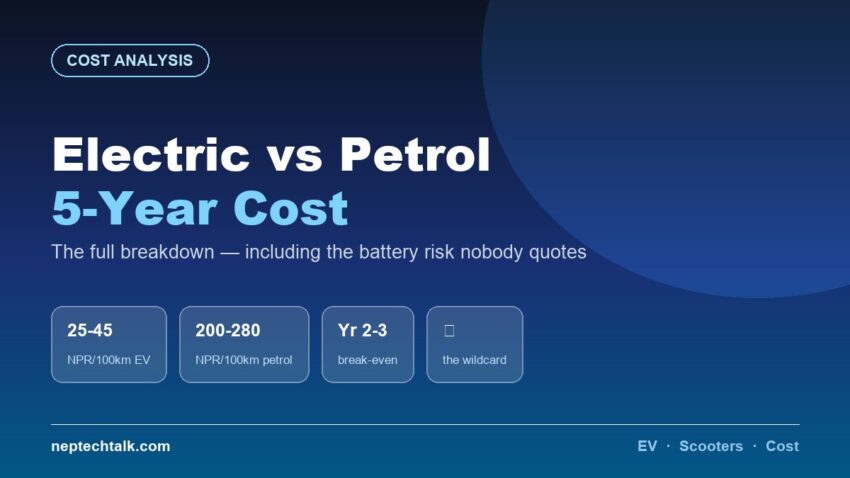
| Energy per 100 km | NPR 200–280 | NPR 25–45 |
| Annual servicing | NPR 4,000–7,000 | NPR 1,500–3,000 |
| Oil changes | Regular | None |
| Brake wear | Normal | Lower (regenerative braking) |
| Battery replacement | Not applicable | The wildcard |
| Resale after 5 years | Established, predictable | Uncertain market |
The energy saving, quantified
This is where electric wins decisively.
For a rider covering 40 km a day, roughly 14,000 km a year:
- Petrol: approximately NPR 28,000–39,000 per year in fuel
- Electric: approximately NPR 3,500–6,300 per year in electricity
A saving in the region of NPR 25,000–33,000 per year, before servicing differences. Over five years, that alone typically exceeds the purchase price premium.
For a low-mileage rider covering 10 km a day, the saving shrinks to roughly a quarter of that, and the arithmetic changes completely. Your annual distance is the variable that decides this.
The servicing saving
An electric scooter has dramatically fewer moving parts — no engine oil, no air filter, no spark plug, no clutch, no complex transmission.
Annual servicing typically costs less than half that of a petrol scooter, and there are fewer things to go wrong. Regenerative braking also reduces brake pad wear meaningfully.
The battery — the honest wildcard
This is the line that decides whether the five-year case holds.
What we know:
- Batteries degrade over time, typically retaining most useful capacity through the warranty period
- Warranties commonly run several years, with a stated capacity threshold
- Replacement cost is a substantial fraction of the scooter’s value
What to do about it:
- Ask the dealer, in writing, what a replacement battery costs today. Our battery replacement guide explains why this is the question dealers avoid.
- Read the warranty terms — duration, kilometre cap, degradation threshold, transferability. Our warranty comparison guide covers the six terms that matter.
- Verify the brand’s Nepali presence is stable. A warranty is a promise from a company that must still exist.
Within five years, a battery under warranty is a manageable risk. Beyond five years, budget for replacement or accept reduced range.
Where the break-even lands
For a daily commuter covering 30–40 km a day: typically year two to three. After that, the electric scooter is saving money every month.
For a rider covering 10–15 km a day: year four to five, or later. The purchase premium takes much longer to recover.
For very low mileage: it may not break even at all within a realistic ownership period.
This is the whole analysis. Calculate your own annual distance first.
The non-financial factors
In favour of electric:
- Silent, no vibration
- No fuel station visits
- No emissions in already-polluted city air
- Simple to operate
Against electric:
- Real range is 60–70% of claimed, less on hills
- Charging arrangements — removable batteries make apartment living far easier
- Thinner service networks
- Long-distance travel is impractical
- Resale market is young and uncertain
In favour of petrol:
- Refuel anywhere in five minutes
- Established service networks nationwide
- Predictable resale value
- No range planning
Frequently asked questions
Is an electric scooter cheaper than petrol in Nepal? Over five years, yes for daily commuters — typically breaking even in year two or three. For low-mileage riders, the case is much weaker.
What is the energy cost difference? Roughly NPR 25–45 per 100 km electric against NPR 200–280 petrol.
What about battery replacement? It is the main financial risk. Get the current replacement price in writing and read the warranty terms before buying.
How much do I need to ride for it to pay off? Roughly 30 km a day or more makes the case comfortably. Under 15 km a day, the payback stretches to year four or five.
Should I still consider petrol? Yes, if you ride long distances, live far from EV service, cannot charge at home, or ride very little.
The bottom line
Electric versus petrol scooter in Nepal comes down to your daily distance. Above roughly 30 km a day, electric breaks even in year two or three and saves money every month afterwards. Below 15 km, petrol is likely cheaper across five years. Get the battery replacement price in writing either way — that is the number that decides whether the saving survives year six.