Updated August 2026. Used prices vary by condition and market — treat any figure as a starting point.
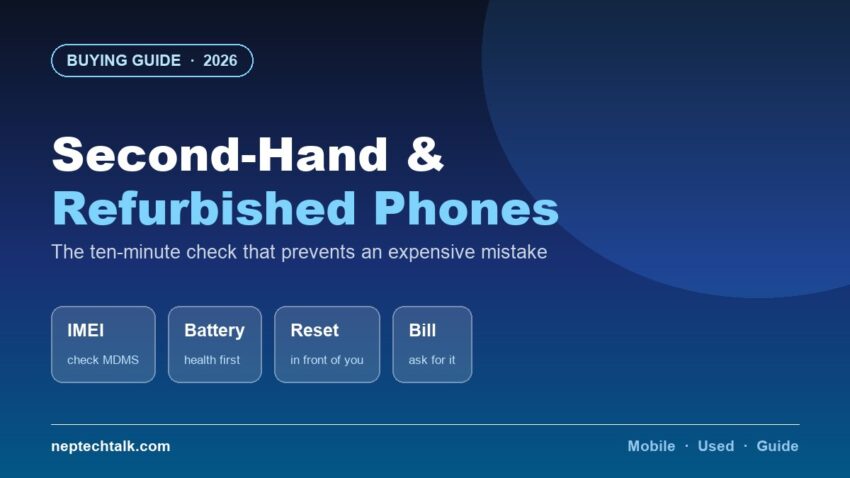
A second-hand phone can be excellent value or an expensive mistake, and the difference is a ten-minute inspection most buyers skip. Here is how to buy a second-hand phone in Nepal safely.
The critical check: IMEI and MDMS
Do this before discussing price. It is not optional.
- Dial \*#06# to display the IMEI
- Check that it matches the IMEI printed on the box and in the phone’s settings
- Verify the IMEI against the MDMS registry — Nepal’s device registration system. An unregistered device can lose network access.
- A phone that fails this check is worthless to you, regardless of condition or price
Walk away from any seller who is reluctant about the IMEI check. A legitimate seller has no reason to hesitate.
The physical inspection
Do this in good light, unhurried, before paying.
- Screen — display a white image full screen to reveal dead pixels, discolouration and burn-in. Then a black image to check for backlight bleed.
- Screen touch response — test every area, including the edges
- Body — dents and bends suggest drops; a bent frame often means internal damage and a broken ingress seal
- Charging port — inspect for corrosion or debris, and test that a cable seats firmly
- All buttons — power, volume, any others
- Cameras — every lens, front and back, plus video
- Speakers and microphone — make a call
- Both SIM slots and, if present, the card slot
- Wi-Fi, Bluetooth and mobile data
- Fingerprint sensor and face unlock
Check for water damage indicators — most phones have a small indicator inside the SIM tray that changes colour on liquid contact. Look at it.
Battery health — the most common disappointment
A used phone with a degraded battery is a phone you will be charging twice a day.
- Where the phone reports battery health in settings, check it. Below roughly 80% of original capacity, factor a battery replacement into the price.
- Where it does not report it, ask how old the phone is and how heavily it was used
- Ask whether the battery has been replaced, and by whom
Battery replacement cost should come off the price if health is poor. This is a legitimate negotiating point.
The seller and the account
- Ask for the original bill and box. Not essential, but a strong signal of legitimate ownership.
- Ask why they are selling. The answer, and how readily it comes, tells you something.
- Have the seller factory reset the phone in front of you, after signing out of their account
- Confirm the phone is not locked to an account. A phone still signed into the previous owner’s account can be locked remotely and becomes unusable. This is the second most common way used phone purchases go wrong, after IMEI problems.
- Meet somewhere public and safe
- Check whether any warranty remains and whether it transfers
Refurbished versus private sale
| Private sale | Refurbished from a shop | |
|---|---|---|
| Price | Lower | Higher |
| Warranty | None | Usually short warranty |
| Inspection | Yours to do | Shop has checked it |
| Recourse if faulty | None | Some |
| Battery | As-is | Often replaced |
A refurbished phone from an established shop with a short warranty is often worth the premium over a private sale — particularly for a buyer who does not want to run the full inspection themselves.
Ask specifically what “refurbished” meant for that unit: was the battery replaced? The screen? Get it in writing.
What to pay
A rough guide, adjusted for condition:
- A one-year-old phone typically sells well below its current new price
- A two-year-old phone falls substantially further
- Beyond three years, software support becomes the limiting factor — check how many years of updates remain, as our last year’s flagship guide covers
Compare against a new budget phone at the same money. Sometimes a new phone at NPR 20,000 with a full warranty and fresh battery is the better purchase than a used mid-range phone at the same price. Run that comparison honestly.
Frequently asked questions
How do I check a second-hand phone in Nepal? Check the IMEI via \*#06# against the MDMS registry first, then inspect the screen, ports, cameras, buttons and battery health before discussing price.
What is the biggest risk? An unregistered or blacklisted IMEI, and a phone still locked to the previous owner’s account. Both make the phone unusable.
Should I buy refurbished instead? Often yes — a short warranty from an established shop is worth the premium over a private sale with no recourse.
How do I check battery health? Where the phone reports it in settings, read it there. Below 80%, factor a replacement into the price.
Is used better value than a new budget phone? Sometimes, sometimes not. Compare a used mid-range against a new budget phone at the same money — the new one has a warranty and a fresh battery.
The bottom line
Buying a second-hand phone in Nepal is safe if you run the checks: IMEI against the MDMS registry first, then screen, ports, cameras, and battery health — and watch the seller factory reset it after signing out. Walk away from anyone reluctant about the IMEI. And compare the price against a new budget phone before assuming used is better value.