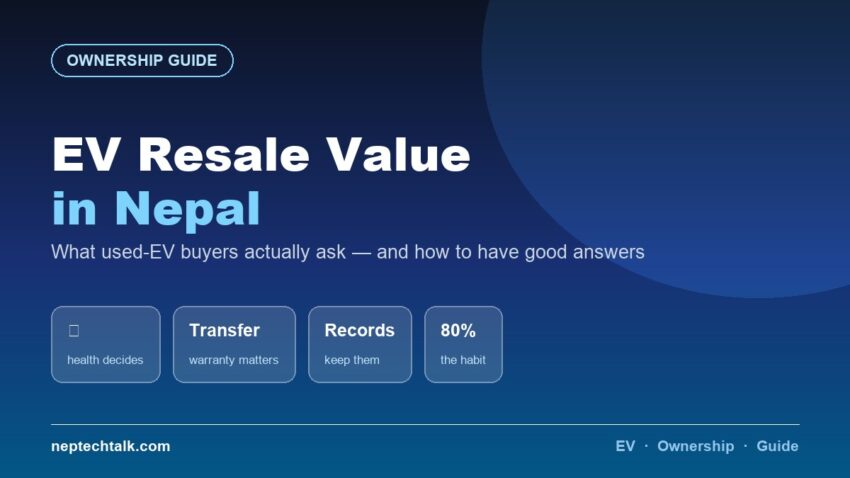
Updated August 2026. Nepal’s used EV market is young — patterns are still forming.
Nepali car buyers plan the exit at the point of purchase, which makes resale a genuine consideration. The honest position on electric car resale value in Nepal is that it is less predictable than for petrol vehicles — and that some of it is within your control.
Why the used EV market is uncertain
1. It is young. Nepal has not yet accumulated a large volume of used EV transactions, so pricing patterns that are well established for petrol cars simply do not exist yet.
2. Battery health is the buyer’s central anxiety, and it is difficult for a used-car buyer to assess independently.
3. Technology moves quickly. A five-year-old EV may have noticeably less range and slower charging than a current one, in a way that a five-year-old petrol car does not lag its successor.
4. Policy changes affect new-car prices, which flows through to used values. As our EV tax guide covers, duty changes move showroom prices — and a drop in new prices pulls used values down with it.
5. Buyer confidence is still building.
What a used EV buyer will actually ask
Prepare for these, because they decide your sale price:
- What is the battery health? The single most important question.
- How much warranty remains, and does it transfer? A transferable battery warranty is worth real money — our warranty guide covers why transferability varies by brand.
- What is the real range now, compared with new?
- How was it charged? Mostly home AC, or frequent DC fast charging?
- What does a replacement battery cost? Our replacement cost guide explains why you should already know this.
- Full service history?
- Is the brand still operating in Nepal?
That last question is the one that most affects value for lower-volume brands. A vehicle from a manufacturer that has exited Nepal is very difficult to sell.
How to protect your resale value
Battery care is the main lever, and it works.
- Charge to 80% for daily use, 100% only before long trips. The single most effective habit.
- Limit DC fast charging to journeys. Frequent rapid charging accelerates degradation, and a buyer who asks will discount for it.
- Avoid extreme heat — park in shade, and do not charge immediately after hard driving
- Do not leave it at 100% or near 0% for extended periods
Documentation is the second lever.
- Keep every service record. A complete history is worth real money at sale.
- Keep the battery warranty documentation and confirm the transfer process in advance
- If your vehicle can produce a battery health report, get one before listing. A documented figure beats an assurance.
- Keep charging records if the vehicle logs them — evidence of mostly-AC charging supports your price
Brand choice at purchase is the third lever, and the one you can only use once. An established manufacturer with a stable Nepali presence will resell more easily than a lower-priced entrant, which is part of what the price premium buys.
The honest comparison with petrol
Petrol vehicles have predictable, well-understood depreciation in Nepal. Our best-selling cars analysis covers why volume models hold value: cheap parts, mechanics everywhere, and a broad buyer pool.
EVs do not yet have that. The used market is forming, and pricing is less consistent.
What this means practically:
- If you plan to keep the vehicle long-term, resale uncertainty matters little and the running cost saving dominates
- If you replace vehicles every three to four years, resale uncertainty is a genuine risk to factor in
- The running cost saving may exceed the resale difference for high-mileage drivers — do that arithmetic with your own numbers
Buying used yourself
If you are on the other side of this transaction, the same questions apply in reverse:
- Ask for a battery health report, not an assurance
- Confirm remaining warranty and whether it transfers to you
- Ask about charging history
- Test the real range on a route you know
- Confirm the brand still operates in Nepal and can service the vehicle
- Get the replacement battery cost before agreeing a price
Frequently asked questions
Do electric cars hold value in Nepal? Less predictably than petrol vehicles — the used market is young and pricing patterns are still forming.
What most affects EV resale value? Battery health, and whether the battery warranty transfers to the new owner.
How do I protect my EV’s resale value? Charge to 80% daily, limit fast charging, avoid heat, and keep complete service and warranty documentation.
Does the brand matter for resale? Substantially. A manufacturer that has exited Nepal leaves a vehicle that is very hard to sell.
Should resale uncertainty stop me buying an EV? Not if you keep vehicles long-term — running cost savings dominate. If you replace every three years, factor it in seriously.
The bottom line
Electric car resale value in Nepal is less predictable than petrol, because the used market is young and battery health is hard for buyers to verify. What you control is real: charge to 80%, limit fast charging, keep every record, and choose a brand that will still be in Nepal when you sell. Do those and you will have good answers to the questions that decide the price.