Checked August 2026. Prices move constantly — verify day-of pricing with authorised sellers.
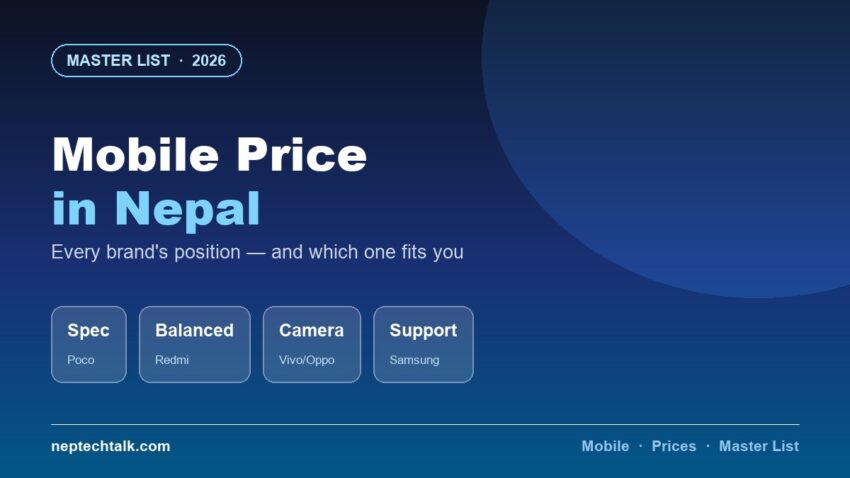
Every brand sold in Nepal is optimising for something different, and knowing what each is optimising for answers the mobile price in Nepal question faster than any price table. Here is the whole market, positioned.
The brands, by what they optimise for
| Brand | Optimises for | Best for |
|---|---|---|
| Samsung | Software support, service reach, all-round quality | Long ownership, service confidence |
| Xiaomi | Balanced specification per rupee | General buyers |
| Redmi | Balanced value | Most buyers |
| Poco | Maximum performance per rupee | Gamers, spec-driven buyers |
| Realme | Charging speed and aggressive pricing | Value buyers who charge in short bursts |
| Vivo | Portrait cameras and design | Photography-first buyers |
| Oppo | Cameras, video and design | Photography-first buyers |
| OnePlus | Flagship performance and clean software | Flagship buyers |
| Nothing / CMF | Design and clean software | Design-led buyers with service access |
| Motorola | Near-stock Android | Clean-software buyers |
| Lava | Budget and feature phones | Entry-level and second phones |
| ZTE / Nubia | Aggressive specifications | Spec buyers who have verified service |
| Google Pixel | Camera processing and clean software | Photography buyers who accept warranty risk |
| Apple | Ecosystem, long support, resale | Apple ecosystem users |
The single most important factor
Service network reach, for every brand.
A phone you cannot get repaired near you is a bad purchase at any price. The volume brands — Samsung, Xiaomi, Redmi, Poco, Realme, Vivo, Oppo — maintain broad networks across Nepal. The lower-distribution brands do not, and that is the trade you are making when their specifications look better.
Rank service access first, then specifications. This single rule prevents most bad phone purchases in Nepal.
By budget
Under NPR 20,000 — budget guide. Prioritise battery and RAM. 5G only if it costs nothing else.
NPR 20,000–30,000 — big-battery guide, 5G guide. 6GB RAM becomes standard; 5G stops being a compromise.
NPR 30,000–50,000 — 50K big-battery guide. IP ratings, fast charging and genuinely good cameras arrive.
NPR 50,000–60,000 — gaming guide. The Poco X7 Pro at 59,999 is the value peak of the market for performance.
Above NPR 60,000 — flagship gaming guide. Cameras, thermals and build quality, not dramatically more speed.
The checks that apply to every purchase
These do not scale with price. Run them at NPR 8,000 and at NPR 1,00,000 alike:
- Dial \*#06# for the IMEI and verify it against the MDMS registry
- Warranty on the bill, with the seller’s stamp
- Confirm the exact variant — RAM and storage configurations vary and pricing follows
- Ask for the software update commitment in years
- Confirm service access in your district
- Check band support for Nepali networks, especially on imported units
- Test everything in the shop — both SIM slots, all cameras, speakers, charging port, network
The comparisons worth reading
- Redmi vs Poco — same company, two strategies. The most useful comparison in the Nepali market.
- Vivo vs Oppo — nearly identical positioning; photograph the same scene on both.
- Android vs iPhone — decided by service, price and resale in Nepal, not software.
- Last year’s flagship — often good value, if enough software support remains.
- Second-hand and refurbished — the ten-minute check that prevents an expensive mistake.
Frequently asked questions
What is the best mobile brand in Nepal? There is no single answer — Redmi for balanced value, Poco for performance, Vivo or Oppo for cameras, Samsung for support and service reach.
How do I choose between brands? Confirm service access in your district first, then match the brand’s strength to your priority: performance, cameras, battery or support.
Which brand offers the best value? Poco for raw specification per rupee; Redmi for balanced value. Our comparison covers the choice.
What checks apply to every phone purchase? IMEI against MDMS, warranty on the bill, exact variant confirmed, update commitment, band support, and testing in the shop.
Does the service network really matter that much? More than any specification. A phone you cannot repair locally is a bad purchase at any price.
The bottom line
The mobile price in Nepal question is really a brand-positioning question: Poco sells performance, Redmi sells balance, Vivo and Oppo sell cameras, Samsung sells support. Pick the one whose strength matches your priority — but confirm service access in your district first, because that outranks every specification on the box.