Updated August 2026
Storage is one of the few phone specifications you genuinely cannot upgrade later on most modern phones, which makes getting it right at purchase important. Here is the honest 128GB vs 256GB guidance for Nepali buyers.
What you actually get
A 128GB phone does not give you 128GB.
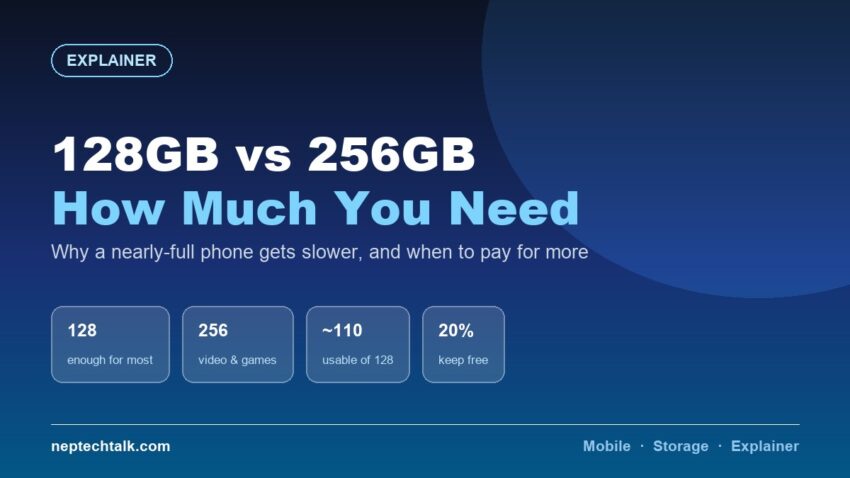
The operating system, pre-installed applications and system files consume a meaningful share before you store anything. Expect roughly 105–115GB usable on a 128GB phone, and proportionally similar on other capacities.
Then account for the 20% you should never fill — see below.
What consumes storage
| Content | Typical demand |
|---|---|
| Operating system and system apps | 15–25GB |
| Ordinary apps | Small individually, substantial together |
| Photos | Moderate — grows steadily over years |
| Videos, especially 4K | Very large |
| Games | Very large — modern titles are enormous |
| Downloaded video and music | Large if you download rather than stream |
| WhatsApp and messaging media | Larger than most people realise |
Two categories dominate: video and games. If you do neither heavily, 128GB is comfortable. If you do either, 256GB is worth it.
Messaging media deserves a mention. Years of WhatsApp photos, videos and forwarded content accumulate to a genuinely surprising volume, and most Nepali users never clear it.
The recommendation
128GB is enough if you:
- Stream music and video rather than downloading
- Take photos but not much 4K video
- Play few or small games
- Back up photos to cloud storage
- Clear messaging media periodically
256GB is worth it if you:
- Record video, especially 4K
- Play large games — our gaming phone guide notes storage matters here
- Download content for offline use, useful on long journeys or where data is expensive
- Keep photos on the device rather than in cloud storage
- Plan to keep the phone four or more years
Below 128GB, do not buy in 2026 unless the phone is a very cheap secondary device. 64GB fills uncomfortably fast.
The performance point people miss
A nearly full phone genuinely runs slower.
Flash storage needs free space to manage writes efficiently. A phone at 95% capacity performs measurably worse than the same phone at 60% — slower app launches, slower saves, and stuttering during recording.
Keep at least 15–20% free. On a 128GB phone that means treating roughly 90GB as your real working capacity.
This is also why storage matters for gaming — a full phone throttles at exactly the moment you want sustained performance.
Expandable storage
Some phones still offer a microSD slot, more commonly at budget and mid-range prices.
Where it helps:
- Photos, videos, music and documents
- Cheap capacity expansion
Where it does not:
- Apps and games generally cannot run properly from a card
- Card speed is far slower than internal storage
- Cheap or counterfeit cards fail, and failure means data loss
A card is a good place for media and a poor substitute for internal storage. Do not buy a 64GB phone assuming a card solves it.
Managing storage on any phone
- Back up photos to cloud storage and remove local copies of older ones
- Clear messaging media — WhatsApp storage management is the single biggest quick win for most users
- Uninstall games you have finished. Modern games are the largest single items on most phones.
- Clear app caches periodically
- Review downloads — files accumulate silently
- Do not let it exceed 85% full
The cost question in Nepal
Storage upgrades are usually priced modestly relative to the phone. The step from 128GB to 256GB typically costs less than the step in RAM at the same tier.
But do not sacrifice RAM for storage. RAM determines how fast the phone feels; storage determines how much it holds. Our buying guides rank RAM higher for exactly this reason — you can manage storage, you cannot manage insufficient RAM.
Frequently asked questions
Is 128GB enough for a phone in 2026? For most users who stream rather than download and do not record much 4K video or play large games, yes.
When should I buy 256GB? If you record 4K video, play large games, download content for offline use, or plan to keep the phone four or more years.
How much of 128GB can I actually use? Roughly 105–115GB, and you should keep 15–20% free — so treat about 90GB as your real capacity.
Does a full phone run slower? Yes, measurably. Flash storage needs free space to manage writes efficiently.
Can a microSD card replace internal storage? For media, yes. For apps and games, no — cards are far slower and apps generally cannot run properly from them.
The bottom line
128GB versus 256GB comes down to video and games: if you do much of either, take 256GB. Otherwise 128GB is comfortable, provided you keep 15–20% free and clear your messaging media occasionally. And never trade RAM for storage — you can manage a full phone, but you cannot manage a slow one.