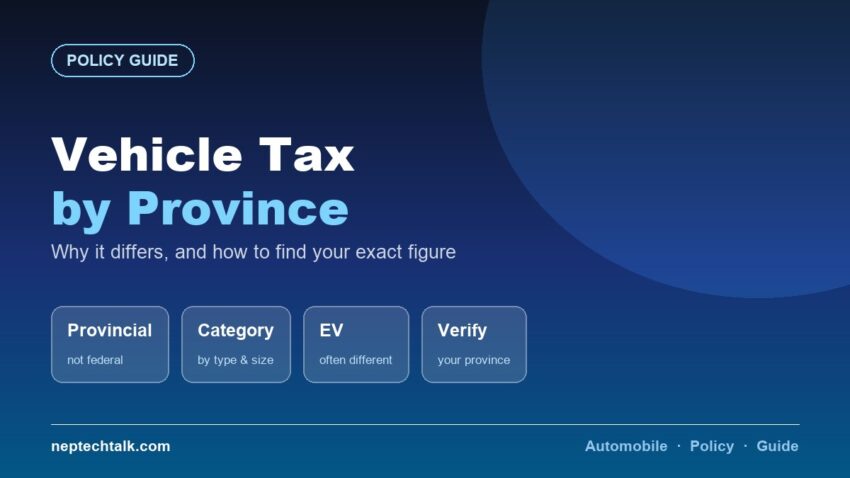
Updated August 2026. Vehicle tax is set provincially and changes with each provincial budget — verify the exact figure for your vehicle with your own provincial transport office or its official website. This article explains the structure, not specific rates.
Vehicle tax in Nepal confuses people because it is not one national figure. It is set by each province, revised in provincial budgets, and structured by vehicle category. Here is how vehicle tax in Nepal actually works, and how to find your number.
Why rates differ between provinces
Vehicle tax is a provincial revenue source, not a federal one.
Under Nepal’s federal structure, provinces set and collect vehicle tax. Each province:
- Sets its own rate schedule
- Revises it in its own annual budget
- Publishes its own categories and thresholds
Consequence: the same vehicle can carry different annual tax in different provinces. A figure quoted for Bagmati does not apply in Gandaki or Lumbini.
This is why you must check your own province. Any article — including this one — quoting a specific number would be wrong for most readers and out of date for the rest.
How the tax is structured
Rates are generally banded by vehicle category and size.
| Factor | Typical effect |
|---|---|
| Vehicle type | Two-wheeler, car, jeep/van, commercial — different schedules |
| Engine capacity (cc) | Petrol vehicles are typically banded by displacement |
| Motor power or battery capacity | Electric vehicles are often banded differently |
| Commercial or private use | Different schedules |
| Vehicle age, in some cases | May affect the applicable rate |
Band thresholds matter. A vehicle just above a displacement threshold can carry noticeably more annual tax than one just below it — worth knowing when choosing between two similar vehicles.
Electric vehicles
EV tax treatment often differs from petrol vehicles, and provincial practice varies.
Where petrol vehicles are banded by engine displacement, electric vehicles have no displacement — so provinces use motor power, battery capacity, or a separate schedule entirely.
Confirm the specific figure for your electric vehicle with your provincial office. Our EV policy overview and EV tax guide cover the customs side; annual road tax is a separate, provincial matter.
How to find your exact figure
- Your provincial transport office — the authoritative source
- The provincial government’s official website, where rate schedules are published
- Your dealer, who should know the figure for a vehicle they are selling — but verify it independently
- Your previous year’s receipt, as a starting point, noting that rates change
Ask specifically for your vehicle’s category and band, not a general range.
Paying on time
Late payment attracts penalties, and they accumulate.
Beyond the fine, unpaid tax creates real problems:
- Bluebook renewal is blocked — tax clearance is required, as our renewal guide explains. The correct order is insurance, then tax, then renewal.
- Insurance claims become complicated. Lapsed road tax gives an insurer grounds to complicate a settlement, as our insurance guide covers.
- Sale is blocked until arrears are cleared
- Transfer of ownership cannot proceed
Set a reminder. This is entirely avoidable administrative cost.
Practical advice
- Confirm your province’s current rate before assuming last year’s figure applies
- Keep every receipt — you need them for bluebook renewal
- Pay before the deadline, not after
- When buying a used vehicle, confirm all tax is cleared before paying. Unpaid arrears become your problem.
- When moving province, check whether your registration and tax obligation change
- Budget for it annually alongside insurance — see our bike loan guide on why financing the purchase does not finance the ownership
Frequently asked questions
Is vehicle tax the same across Nepal? No. It is set provincially, and each province publishes its own schedule and revises it in its own budget.
How is vehicle tax calculated? By vehicle category and size — typically engine displacement for petrol vehicles, and motor power or battery capacity for electric ones.
How do I find my exact rate? From your provincial transport office or the provincial government’s official website. Ask for your vehicle’s specific category and band.
Is EV tax different? Often, yes, and provincial practice varies. Confirm the specific figure for your vehicle.
What happens if I pay late? Penalties accumulate, bluebook renewal is blocked, insurance claims become complicated and you cannot sell the vehicle.
The bottom line
Vehicle tax in Nepal is provincial, banded by category and size, and revised every provincial budget — so there is no single national figure to look up. Get yours from your provincial transport office, keep the receipts for bluebook renewal, and pay before the deadline. If you are buying used, confirm all arrears are cleared before you hand over money.