Updated August 2026. Insurance terms change — verify with your insurer and the Nepal Insurance Authority.
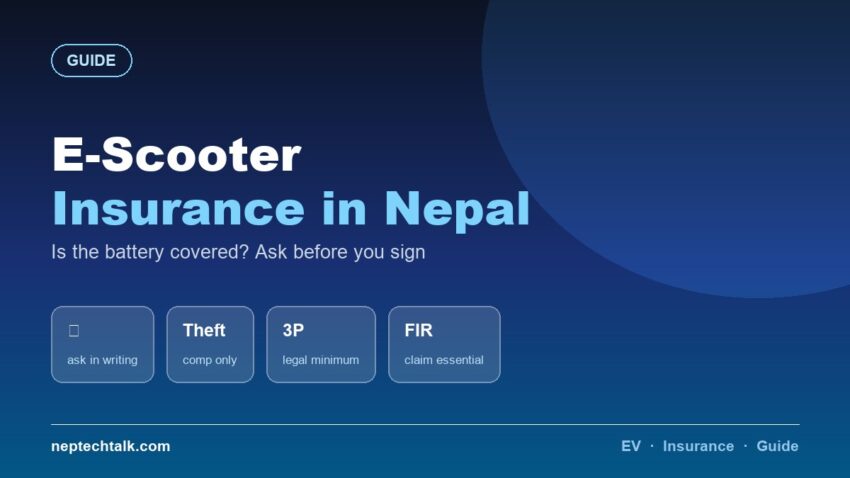
Insuring an electric scooter in Nepal follows the same legal framework as any two-wheeler, with one question that does not arise for petrol vehicles. Here is what to check on electric scooter insurance in Nepal.
The framework
As with any two-wheeler, our insurance guide applies:
- Third-party cover is legally required
- Comprehensive is optional but covers your own vehicle and theft
- A financed scooter will require comprehensive from the lender
The battery question — ask this first
Is the traction battery covered, and to what extent?
The battery is a large share of an electric scooter’s value — proportionally more than on an electric car, because the vehicle itself costs less. Our battery replacement guide explains why you should already know the replacement cost.
Ask in writing:
- Is accidental damage to the battery covered?
- Is water and flood damage to the battery covered? Genuinely relevant in monsoon.
- Is fire involving the battery covered?
- Is depreciation applied to a battery claim? At what rate?
- Are there exclusions relating to the battery or charging equipment?
A policy that excludes or heavily depreciates the battery covers substantially less than its premium suggests.
Why theft cover matters most
Third-party insurance pays nothing if your scooter is stolen.
Two-wheeler theft is a genuine risk in Nepali cities, and an electric scooter parked on a street or in a shared compound is as vulnerable as any other.
If losing the scooter tomorrow would be a financial problem, you need comprehensive cover. That is the whole test — and for a vehicle that costs more than an equivalent petrol scooter, it applies more strongly.
With removable batteries, ask whether the battery is covered if stolen separately from the scooter. This is a real scenario and a common gap.
What typically excludes cover
Read your policy schedule. Common exclusions:
- Riding without the correct licence category. For electric scooters this deserves attention — licence requirements can depend on the vehicle’s classification, as our registration guide covers. Riding without the correct category voids the claim.
- Riding under the influence
- Wear and tear, and battery degradation — this is normal ageing, not a claim
- Using non-approved charging equipment, in some policies
- Commercial use of a privately-insured vehicle — relevant for delivery riders
- Depreciation on replaced parts, unless zero-depreciation cover is bought
Claims: the documentation
The same discipline as any Nepali motor claim:
- Report to police and obtain an FIR for any accident, theft or third-party involvement. For theft, absolute.
- Notify the insurer immediately — the window is short
- Photograph everything before the scooter is moved
- Do not begin repairs before the surveyor inspects — the most common cause of rejection
- Keep the bluebook, licence, policy and tax clearance current
For an electric scooter specifically: if it has been in water, tell the insurer and dealer before charging or riding it. Our safe charging guide covers why water and lithium batteries are a safety issue, not just a claims one.
Practical buying advice
- Compare at least three insurers. EV pricing varies more than petrol pricing because insurers are still calibrating.
- Check the claim settlement record, not just the premium
- Declare accurately — the vehicle’s use and the usual rider
- Ask whether charging equipment is covered, and under which policy
- Note the no-claim bonus — it changes the arithmetic on claiming for minor damage
- Understand the excess before comparing premiums
Frequently asked questions
Is electric scooter insurance different in Nepal? The legal framework is identical to any two-wheeler, but battery coverage is an additional question that does not arise for petrol scooters.
Is the battery covered? It varies by policy and is often unclear. Ask in writing about accidental, flood and fire damage, and whether depreciation applies.
Does third-party cover theft? No. Theft is covered only under comprehensive — and for a street-parked scooter in a Nepali city, that is the difference that matters most.
Does the licence category affect my claim? Substantially. Riding without the correct category for your vehicle’s classification voids the claim. Confirm which category applies.
What most often causes a rejected claim? Starting repairs before the surveyor inspects, and missing police documentation.
The bottom line
Electric scooter insurance in Nepal turns on two questions the brochure will not answer: is the traction battery covered, and is the battery covered if stolen separately. Get both in writing, take comprehensive if theft would hurt financially, and confirm you hold the correct licence category — because that one voids claims entirely.