Checked August 2026. Availability and pricing change — confirm current models with authorised dealers.
Electric motorcycles sit between electric scooters and electric cars in the Nepali market, and they are less established than either. Here is what an electric motorcycle in Nepal actually offers and what to verify before buying.
How they differ from electric scooters
| Electric scooter | Electric motorcycle | |
|---|---|---|
| Riding position | Step-through, feet forward | Conventional, straddled |
| Performance | Adequate for city | Higher, better for highways |
| Battery | Often removable | Usually fixed |
| Weight | Lighter | Heavier |
| Storage | Under-seat | Minimal |
| Price | Lower | Higher |
| Charging | Standard socket workable | May need a proper point |
The removable battery point matters most in Nepal. As our charging guide covers, a removable battery lets an apartment dweller carry it inside — with a fixed battery, you need parking with a power point and, usually, building permission.
Establish this before buying, not after. It is the most common reason an EV purchase becomes frustrating.
What to expect on range
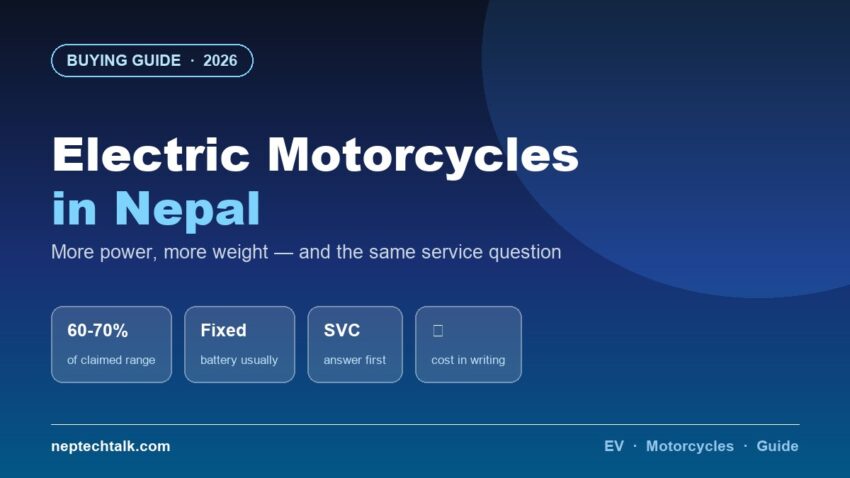
The same derating applies as for electric scooters: expect 60–70% of the claimed figure, and less on hills with a pillion.
Manufacturers test on flat ground, at low constant speed, with a light rider and a new battery. None of that describes a Nepali commute.
Size for your worst realistic day: take your longest regular round trip, double it, and buy a motorcycle claiming at least that. This sounds excessive and is not — it is what covers hills, a pillion, a winter morning and a battery in year three.
The service question — answer this first
This should shape your shortlist before you compare a single specification.
Electric motorcycles are a newer, lower-volume segment in Nepal than electric scooters, which makes the service question sharper. As our EV service guide sets out, ask for written answers:
- Where exactly can this be serviced? Actual addresses, not a claim of national coverage.
- Are the technicians trained on this specific vehicle?
- What parts are stocked in Nepal, and what is imported to order?
- Who handles battery diagnostics and repair? Can modules be replaced individually?
- How long has this brand operated in Nepal, and how many units are on the road?
Question 5 predicts the others. And a warranty is a promise from a company that must still exist to honour it — our warranty guide covers why brand stability is the largest risk with lower-volume EV brands.
The battery cost question
Get the replacement battery price in writing before purchase.
Our battery replacement guide explains why dealers avoid this question and why you should insist. On a motorcycle, the battery is a large share of the vehicle’s value, and it is the number that decides whether the ownership case holds beyond the warranty period.
Also read the warranty terms properly: duration and kilometre cap, degradation threshold, pro-rata structure, transferability, remedy and exclusions.
The cost case
The same arithmetic as our electric vs petrol scooter breakdown:
- Energy costs roughly a tenth of petrol per kilometre
- Servicing costs roughly half, with no oil, filters, plugs or clutch — see our maintenance guide
- Break-even typically arrives in year two or three for a daily commuter, later for low-mileage riders
Calculate with your own annual distance. Above roughly 30 km a day the case is comfortable; below 15 km a day, petrol is likely cheaper across five years.
Resale
The used market is young and less predictable than for petrol motorcycles, where popular commuter models have well-understood values.
Our electric scooter resale guide applies directly: battery health, warranty transferability and brand survival decide the price. Charge to 80% daily, keep every record, and buy from a brand that will still be in Nepal when you sell.
Buying checks
- Confirm service access in your district — before discussing price
- Get the replacement battery cost in writing
- Read the battery warranty terms, all six of them
- Test ride on a hill, with a pillion if you carry one
- Confirm the charging arrangement works where you park
- Confirm the licence category required — see our registration guide
- Get insurance quoted before purchase, and ask whether the battery is covered
Frequently asked questions
What is the electric motorcycle price in Nepal? Availability and pricing vary and the segment is small — confirm current models with authorised dealers. Service access matters more than price here.
How do electric motorcycles differ from electric scooters? Conventional riding position, more performance, heavier, and usually a fixed rather than removable battery — which affects apartment charging.
What real range should I expect? Roughly 60–70% of the claimed figure, and less on hills with a pillion. Size for double your longest regular round trip.
What should I check before buying? Service access in your district, the replacement battery cost in writing, and the battery warranty terms. Those three, before price.
Is it cheaper than petrol? For a daily commuter above roughly 30 km a day, yes — typically breaking even in year two or three. Below 15 km a day, likely not.
The bottom line
Electric motorcycles in Nepal offer the running-cost case of an electric scooter with more performance and, usually, a fixed battery that complicates apartment charging. Answer the service question before the price question, get the replacement battery cost in writing, and expect 60–70% of the claimed range. If nothing serviceable exists near you, that is your answer.