Checked August 2026. Verify current pricing with authorised sellers.
A phone for content creation is bought on different criteria from a phone for photographs. The best phone for content creators in Nepal is chosen on video capability — and the most important upgrade is not the phone at all.
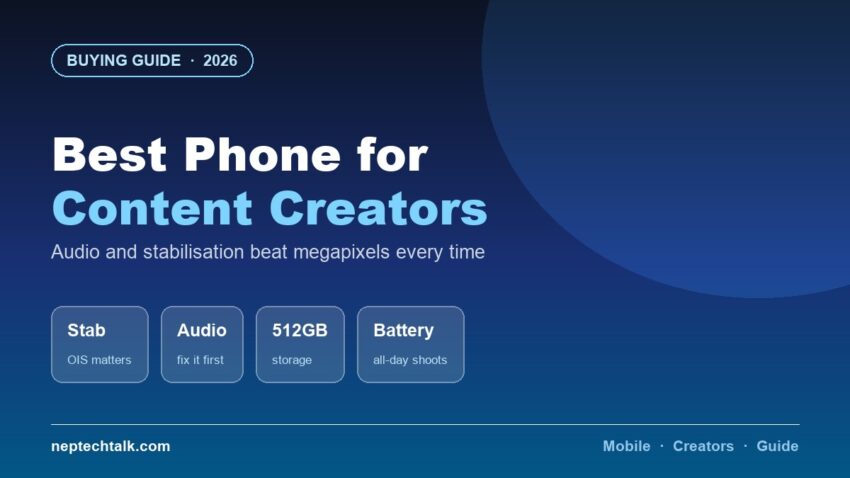
The priority order for video
| Priority | Specification | Why |
|---|---|---|
| 1 | Stabilisation (OIS) | Handheld footage is unwatchable without it |
| 2 | Audio quality | Viewers forgive bad video; they leave over bad audio |
| 3 | Storage | Video files are enormous |
| 4 | Battery | All-day shooting |
| 5 | Low-light video | Indoors and evening shoots |
| 6 | Thermal management | Long recordings cause shutdowns |
| 7 | Photo megapixels | Least important here |
Note where megapixels sit. As our megapixels vs sensor size explainer covers, the headline figure tells you little about photographs and even less about video.
Stabilisation is the first thing to test
Optical image stabilisation is what separates usable handheld footage from unwatchable footage.
Test it in the shop: record a clip while walking. Play it back. If it is jittery, no amount of editing will fix it.
Electronic stabilisation helps but crops the frame and can produce artefacts. Optical stabilisation is the specification to insist on.
Audio — fix this before you upgrade the phone
This is the single highest-return improvement available to a Nepali creator, and it costs a fraction of a new phone.
Phone microphones are adequate in a quiet room and poor everywhere else. Kathmandu is not a quiet room.
Buy an external microphone. A basic lavalier or shotgun microphone transforms your output more than any camera upgrade. Viewers tolerate mediocre video; they stop watching over bad audio.
Check your phone supports external microphone input — via USB-C or wirelessly — before buying either.
Storage — plan for it
Video consumes storage faster than anything else, as our storage explainer covers.
256GB is the minimum for a creator; 512GB is better. And keep 15–20% free, because a nearly full phone throttles and drops frames during recording.
Offload footage regularly to a computer or external drive. Do not treat the phone as your archive.
Thermal management
Long video recording generates heat, and a hot phone stops recording.
As our overheating guide covers, Nepali conditions make this worse. What helps:
- Remove the case while recording
- Do not record in direct sun — shade the phone between takes
- Do not charge while recording if you can avoid it
- Keep storage free
Read reviews that test sustained recording, not just clip quality. A phone that shuts down after twelve minutes is not a video phone.
What to buy
NPR 40,000 — capable for casual creation, with real low-light limitations.
NPR 60,000 — good video with stabilisation, generous storage. The Poco X7 Pro’s 512GB is genuinely useful here, though it is tuned for performance rather than cameras.
NPR 75,000–1,00,000 — Vivo X200 at 74,999 and Oppo are camera- and video-led. This is where video quality becomes genuinely good.
Above NPR 1,00,000 — flagship video capability, best stabilisation and low-light performance. For someone earning from content, this is where the money is justified.
iPhone — historically strong for video, but settle the Nepali warranty and service question first.
The rest of the kit
In order of what improves your output most:
- An external microphone — the biggest single gain
- A tripod or gimbal — stability beyond what OIS provides
- Lighting — a basic LED panel transforms indoor footage
- Power bank — all-day shooting drains batteries
- Extra storage — a laptop or external drive to offload to
Spending NPR 15,000 on a microphone, tripod and light improves your output more than spending NPR 40,000 more on a phone. That is the honest ranking.
Frequently asked questions
What is the best phone for content creators in Nepal? One with optical stabilisation, external microphone support and 256GB+ storage. Above NPR 75,000, video quality becomes genuinely good.
What matters most for video? Stabilisation first, then audio. Megapixels matter least.
Do I need an external microphone? Yes. It is the highest-return improvement available and costs far less than a phone upgrade.
How much storage do I need? 256GB minimum, 512GB preferred — and keep 15–20% free, because a full phone drops frames.
Should I buy a more expensive phone or better accessories? Accessories, until you have a microphone, tripod and light. Then the phone.
The bottom line
The best phone for content creators in Nepal has optical stabilisation, external microphone support and at least 256GB of storage — test the stabilisation by recording while you walk before buying. But buy the microphone first: it improves your output more than the next NPR 40,000 of phone, and viewers leave over audio long before they leave over video.