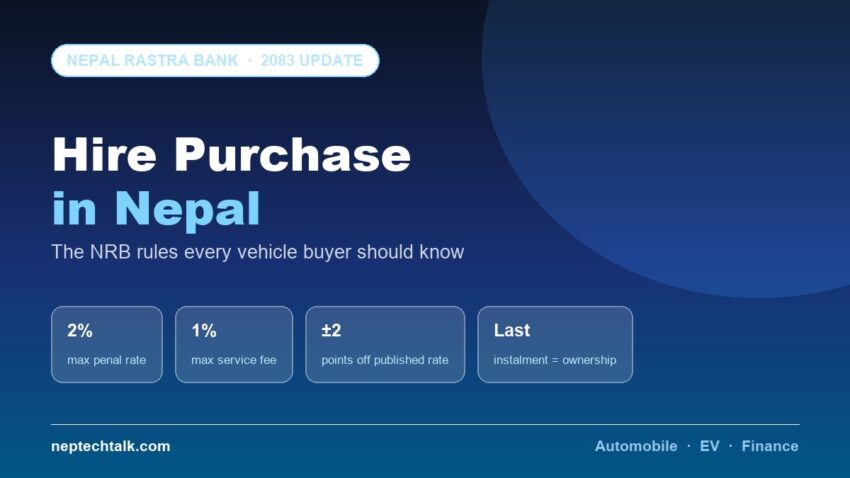
Updated: August 2026 — based on Nepal Rastra Bank’s sixth amendment (2083) to the hire purchase policy
Hire purchase in Nepal is how most people actually buy a scooter, bike, EV or car. Not with cash — with a fixed monthly instalment, arranged at the showroom, signed in ten minutes, and then paid off over the next three to five years.
What almost nobody reads is the rulebook behind that ten-minute signature. Nepal Rastra Bank (NRB) sets it, and in 2083 it issued the sixth amendment to “हायर पर्चेज कर्जा दिने कम्पनीलाई स्वीकृति दिने नीतिगत एवम् प्रक्रियागत व्यवस्था, २०७०” — the policy that governs which companies may offer hire purchase and on what terms.
Buried in that document are several caps that directly limit what a finance company can charge you. This guide pulls out the parts that matter to a buyer.
> Note on sourcing: this article summarises NRB’s official notice. It is general information, not legal or financial advice. Confirm any figure with your lender and the current NRB circular before you sign.
Quick answer: what hire purchase actually means
NRB’s own definition is more specific than most showrooms explain:
| What it covers | Vehicles, machinery and tools, plus household electricals — washing machines, refrigerators, vacuum cleaners, dishwashers and similar equipment |
| What it is for | Agricultural, industrial, commercial or household (घरायसी) purposes |
| Who can take it | Any individual, firm, company or institution |
| How it is repaid | In instalments (किस्ताबन्दी) |
| When you own it | Only after every instalment is paid — ownership transfers at the end, not the start |
That last row is the single most important line in the whole policy. Under hire purchase you are, in law, hiring the vehicle until the final payment clears. The financier holds ownership in the meantime, which is exactly why they can repossess it far more easily than a bank can chase an ordinary loan.
The four caps that protect your wallet
This is where the policy earns its keep. Section 10.3 sets hard limits on what a hire purchase company can charge.
1. The interest rate must be published — and cannot swing more than 2 points
A hire purchase company has to set its rate using Cost of Fund as the base, calculated from the cost of its own capital and the weighted cost of borrowed funds. It must then publish that rate, and report it to NRB’s supervision department within three days of setting it.
When quoting an individual customer, the company cannot deviate more than 2 percentage points from its published rate.
In practice: the rate you are offered is not supposed to be invented at the desk. Ask for the published rate. If your quote is more than two points above it, that is outside the rule.
2. Penal interest is capped at 2 percentage points
If you miss an instalment, the contract may state an annual penal rate — but it cannot exceed 2 percentage points.
3. No interest on penal interest
The policy is explicit: penal interest is calculated only on the principal of the overdue instalment, for the period of the delay. Charging interest on the penal interest, or applying it to more than the overdue amount, is not allowed.
This kills the compounding spiral that used to turn one missed payment into a much larger problem.
4. Service charge capped at 1%
A hire purchase company may charge a service fee of at most 1% of the approved loan. It may pass on genuine third-party costs, but only at cost — not marked up.
| Charge | NRB ceiling |
|---|---|
| Deviation from published interest rate | ± 2 percentage points |
| Penal interest rate (annual) | 2 percentage points |
| Interest charged on penal interest | Not permitted |
| Service charge | 1% of approved loan |
Before signing, ask for these four numbers in writing. A lender that will not put them on paper is telling you something.
What a legitimate hire purchase company looks like
Not every showroom offering “easy EMI” is licensed to lend. NRB sets a firm bar:
| Requirement | Rule |
|---|---|
| Registration | Registered under the Company Act 2063 specifically as a hire purchase company |
| Approval | Separate approval from NRB under Section 76 of the Nepal Rastra Bank Act 2058 |
| Minimum paid-up capital | NPR 30 crore in ordinary shares |
| Company name | Must contain “हायर पर्चेज” — e.g. “………… हायर पर्चेज प्रा.लि.” |
| Application fee | 0.2% of paid-up capital, non-refundable |
| Renewal | Every ten fiscal years, by end of Shrawan, fee NPR 2,00,000 |
| Deposits | Prohibited — a hire purchase company may not collect deposits or savings in any form |
| Other lending | Prohibited — hire purchase only; no other loans, no other business |
Two of those deserve emphasis.
They cannot take your deposit. If a company offering hire purchase also invites you to park savings with it, that is outside its licence.
They cannot lend for anything else. A licensed hire purchase company does business in hire purchase and nothing else.
The 2083 amendment also relaxed the renewal cycle to once every ten fiscal years, with late renewal costing 10% extra until end of Bhadra and 20% extra until end of Ashoj. Miss that, and the approval is automatically cancelled.
The multi-brand rule — why it matters at the showroom
Section 10.15 requires a hire purchase company to finance vehicles, machinery and equipment from more than one brand, and to publish that information on its website.
This is aimed squarely at captive financing — the arrangement where a dealer’s in-house finance arm will only fund that dealer’s stock. Under the rule, a licensed company has to spread across brands and say so publicly.
For you as a buyer, that is a practical test: check the financier’s website. If it lists only one brand, ask why.
How to check your lender is actually approved
- Read the company name. A licensed hire purchase company’s registered name must contain “हायर पर्चेज”. A name without it is a signal to ask more.
- Ask for the NRB approval letter issued under Section 76, and check the renewal is current.
- Ask for the published interest rate, then compare it against what you are being quoted — the gap cannot exceed 2 percentage points.
- Check the website for the interest rate notice, the multi-brand disclosure and the list of contact offices. NRB requires all three to be published.
- Confirm the paperwork names a company, not an individual. Hire purchase is a licensed corporate activity.
- Cross-check with NRB. Nepal Rastra Bank publishes its licensed institutions; if in doubt, contact the Bank and Financial Institution Regulation Department.
What happens if you fall behind
Two mechanisms kick in, and it is worth knowing both before you commit.
Your loan gets classified. NRB requires the company to grade overdue accounts and set aside provisions:
| Classification | Overdue by | Provision the company must hold |
|---|---|---|
| असल (Pass) | Up to 6 months | — |
| शंकास्पद (Doubtful) | More than 6 months | 50% of the overdue instalment |
| खराब (Loss) | More than 1 year | 100% of the total outstanding |
Doubtful and Loss accounts are classed as निष्क्रिय कर्जा (non-performing), and interest on them is recognised only when cash is actually received.
The vehicle can be taken back. Section 10.12 explicitly contemplates the company repossessing the vehicle, machinery or equipment when instalments and interest cannot be recovered. The recovered asset is then depreciated under prevailing income tax law and booked at its remaining value.
Because ownership sits with the financier until your final payment, repossession is structurally easier here than under a conventional loan. That is the trade-off you accept for a fast approval at the showroom counter.
One more thing worth knowing: for hire purchase loans above NPR 10 lakh, the company must mandatorily pull your credit information. Your repayment record follows you.
Rescheduling is possible but narrow. Under Section 10.11, a loan can be rescheduled only where the regulator has issued a directive for special circumstances, and only if you make a written request with valid reasons that the company’s board then approves. It is not something the branch can grant informally.
Hire purchase vs a bank auto loan
Both get you the vehicle. They are not the same product.
| Hire purchase company | Bank / finance company auto loan | |
|---|---|---|
| Ownership during the term | Financier holds it until the last instalment | Usually yours, with the vehicle pledged as security |
| Where you apply | Usually at the showroom | At the bank |
| Speed | Faster, dealer-integrated | Slower, more documentation |
| What else they can offer you | Hire purchase only, by law | Full range of banking products |
| Deposits | Cannot accept any | Accepts deposits |
| Repossession | Structurally easier for the lender | Requires the security enforcement process |
Neither is automatically better. Hire purchase is quicker and often available to people a bank would decline. A bank loan usually gives you a stronger ownership position. What matters is that you know which one you are signing.
Separately, NRB sets loan-to-value (LTV) ceilings for vehicle financing through its directives — reported to have been tightened to 60% for private fossil-fuel vehicles and EVs alike, down from a more generous EV ceiling previously. LTV is set outside this particular notice and changes with monetary policy, so confirm the current figure with your lender before you budget your down payment.
What this means if you are buying an EV
Electric two-wheelers and cars are among the fastest-growing hire purchase categories in Nepal, and the rules above apply to them exactly as they do to a petrol scooter.
Three things to weigh:
- The LTV ceiling drives your cash requirement. If financing is capped at 60% of value, a NPR 3,00,000 electric scooter needs roughly NPR 1,20,000 up front. Budget from the LTV, not the sticker price.
- The loan usually outlasts the battery warranty. Check the battery warranty term against your instalment term before you sign — a replacement cost landing mid-loan changes the maths entirely.
- Resale is your exit. Because the financier owns the vehicle until you finish paying, selling mid-term means settling the loan first. On a segment where resale values are still unsettled, that matters.
Frequently asked questions
Do I own the vehicle during a hire purchase agreement in Nepal? No. Under NRB’s definition, ownership transfers only after all instalments are paid. Until then the financier holds it and you are, legally, hiring.
What is the maximum penal interest a hire purchase company can charge? The contract cannot state an annual penal rate above 2 percentage points, and penal interest applies only to the overdue instalment’s principal for the delay period. Charging interest on penal interest is not allowed.
How much can a hire purchase company charge as a service fee? Up to 1% of the approved loan. Genuine third-party costs may be passed on, but only at actual cost.
Can a hire purchase company take my savings or fixed deposit? No. Hire purchase companies are prohibited from collecting deposits or savings in any form. They also cannot provide any other type of loan or run any other business.
How do I know a hire purchase company is licensed by NRB? Its registered name must contain “हायर पर्चेज”, it must hold approval under Section 76 of the NRB Act 2058 with a current renewal, and it must publish its interest rates and multi-brand disclosure on its website. Ask to see the approval letter.
What happens if I miss instalments? Your account is classified — Doubtful after six months overdue, Loss after a year — your credit record is affected on loans above NPR 10 lakh, and the financier may repossess the vehicle, since it owns it until you finish paying.
Can I reschedule my hire purchase loan? Only in limited circumstances: where the regulator has issued a directive for special situations, and after a written request with valid reasons is approved by the company’s board.
The short version
Hire purchase is how a large share of Nepal’s bikes, scooters, EVs and cars actually get bought, and the terms are more regulated than most buyers realise. Before you sign at the showroom counter, get four numbers in writing: the published interest rate, your quoted rate, the penal rate, and the service charge. Then check that the company’s name carries “हायर पर्चेज” and that its NRB approval is current.
Ten minutes of questions at the counter is cheap insurance on a commitment you will carry for the next four years.
Internal link opportunities: link to the EV price lists, the bike price lists, and a future “Bike Loan in Nepal: Banks, Rates and Process” post. This article is the natural pillar for the whole vehicle-finance cluster.
Sources: Nepal Rastra Bank official notice (PDF) · Nepal Rastra Bank