Checked August 2026. Campaign pricing moves this category — bands below are the durable guide.
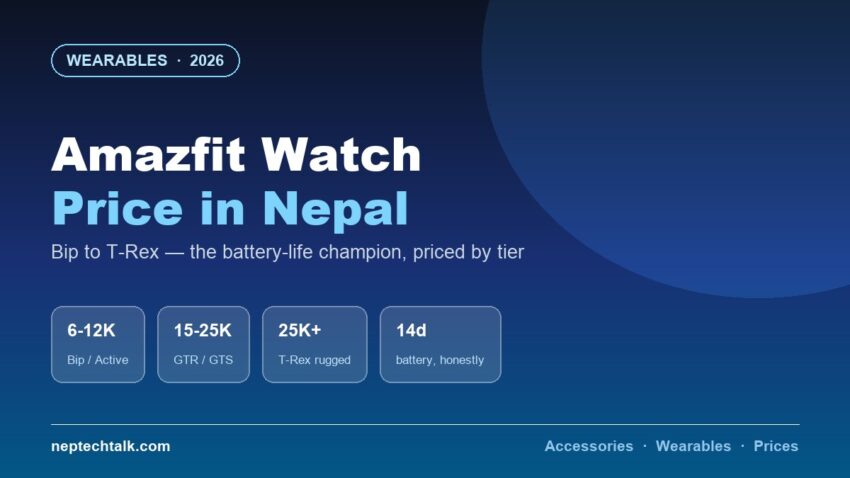
Amazfit wins Nepal’s smartwatch value argument on one specification nobody else matches at the price: battery life measured in weeks, not days. The Amazfit smartwatch price in Nepal spans roughly NPR 6,000 to 40,000 across four families.
Amazfit bands in Nepal
| Band (NPR) | Family | What you get |
|---|---|---|
| 6,000–12,000 | Bip / Active | Basic tracking, 2-week battery, light build |
| 12,000–18,000 | GTS / GTR entry | AMOLED, GPS, better sensors |
| 18,000–28,000 | GTR upper | Premium build, dual-band GPS, long battery |
| 25,000–40,000 | T-Rex | Rugged, military-spec styling, biggest batteries |
Why battery life is the whole argument
An Apple Watch or Galaxy Watch needs charging nightly or every other day. An Amazfit Bip or GTR runs one to two weeks. In Nepal — where load-shedding still happens, where a trek or a village trip means unreliable power, and where charging discipline is a real burden — this difference is not a spec-sheet nicety. It is the reason to buy the brand.
The trade: fewer apps, no cellular, weaker ecosystem integration, and health sensors that are good rather than medical-grade.
Which Amazfit to buy
Bip / Active (NPR 6,000–12,000) — the sensible first smartwatch. Notifications, steps, sleep, heart rate, two-week battery. For most Nepali buyers wanting a smartwatch rather than the smartwatch, this tier is genuinely enough — and it undercuts the Noise/Fire-Boltt tier on software polish.
GTS / GTR (NPR 12,000–28,000) — the proper watch. AMOLED screens, built-in GPS for running and cycling, better sensors. The GTR’s round face and week-plus battery is the sweet spot of the whole lineup.
T-Rex (NPR 25,000–40,000) — the outdoor pick. Rugged construction, huge battery, styled for trekking and fieldwork. In a country where people actually walk mountains, this line has a genuine local case that its global marketing only claims.
Amazfit vs the alternatives
- vs Galaxy Watch: Samsung wins apps, calls, ecosystem and health depth; Amazfit wins battery and price by large margins. Galaxy phone owners who charge nightly should consider Samsung; everyone else, Amazfit.
- vs Noise/Fire-Boltt: Amazfit costs more and delivers noticeably better software, sensors and build — the gap is real.
- vs Apple Watch: different universes; only relevant if you own an iPhone and want deep integration.
Buying discipline: authorised sellers, warranty on the bill, and the same counterfeit vigilance the earbuds category demands.
Frequently asked questions
What is the cheapest Amazfit in Nepal? Bip-series models from about NPR 6,000–8,000 at official sellers.
How long does the battery really last? Bip-class: up to two weeks in normal use. GTR-class: a week-plus with GPS use. Always-on display and constant GPS cut these substantially — the claims assume typical settings.
Amazfit or Galaxy Watch in Nepal? Galaxy Watch for Samsung phone owners wanting calls and apps; Amazfit for anyone who values two-week battery and lower prices. Both are good — they answer different questions.
Is Amazfit accurate for health tracking? Good for trends — steps, sleep patterns, resting heart rate. Not a medical device on any brand at this price; treat SpO2 and blood-pressure-style features as indicative only.
Does it work with any phone? Yes, Android and iPhone via the Zepp app, with fuller functionality on Android.
The bottom line
The Amazfit smartwatch price in Nepal — roughly NPR 6,000 to 40,000 — buys the market’s best battery life per rupee, and in Nepali conditions that specification matters more than app counts. Take the Bip tier for a first watch, the GTR for the sweet spot, the T-Rex if you spend real time outdoors. Checked August 2026.