Updated August 2026. Verify current pricing — both brands discount frequently.
Vivo and Oppo occupy nearly identical positions in the Nepali market: camera-led, design-conscious, heavily marketed, and priced above what their raw specifications alone justify. The Vivo vs Oppo question has a clear answer, and it comes with a caveat both brands share.
The two brands, compared
| Vivo | Oppo | |
|---|---|---|
| Camera focus | Portrait and low light | Portrait and video |
| Design | Consistently strong | Consistently strong |
| Software | Funtouch OS | ColorOS |
| Charging speed | Fast | Fast |
| Specification per rupee | Moderate | Moderate |
| Service network in Nepal | Broad | Broad |
| Resale | Reasonable | Reasonable |
They are more similar than different. Both are camera-and-design-led brands from the same corporate family tree, competing in the same segments with comparable service networks in Nepal.
The concrete comparison
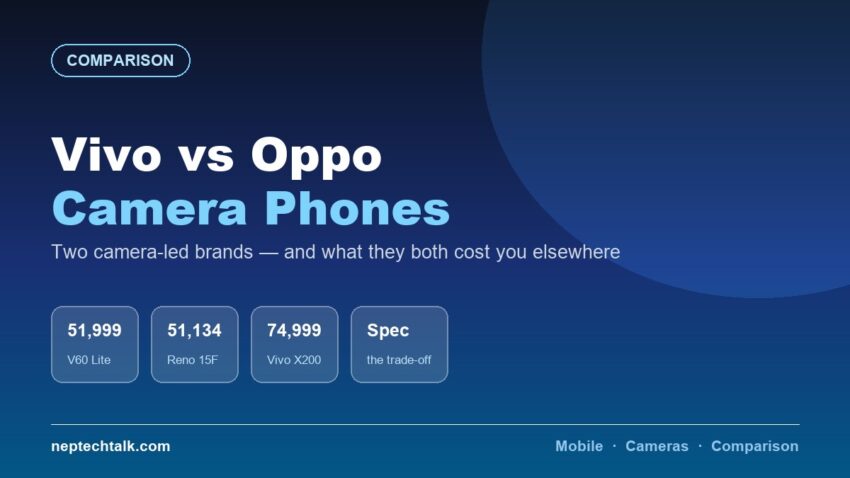
Vivo V60 Lite 5G at NPR 51,999 and Oppo Reno 15F from NPR 51,134 sit almost exactly together — the closest direct comparison in the Nepali market.
At that price, choose on:
- Which camera output you prefer — go to a shop and photograph the same scene on both
- Which software you find less irritating — both skins are heavy; opinions differ on which is worse
- Which is discounted that week — the gap moves
Vivo X200 at NPR 74,999 moves into genuine flagship camera territory and is the stronger of the two brands’ upper offerings currently available.
What both do genuinely well
1. Portrait photography. Both brands tune specifically for this, and it shows. Skin tones, subject separation and background rendering are handled better than most competitors at the same price.
2. Front cameras. Both prioritise selfie quality more than most brands, which for a large share of buyers is the camera that matters most.
3. Design and build. Consistently among the best-finished phones at their price points.
4. Fast charging. Both are strong here.
5. Service networks in Nepal — broad, which removes service reach as a deciding factor between them.
The caveat both share
You pay a premium for cameras and design, and it comes out of raw specification.
At NPR 51,999, the Poco X7 Pro at NPR 59,999 offers dramatically more chipset for NPR 8,000 more, and the Redmi Note 15 Pro+ at NPR 63,999 offers a larger battery and better ingress protection.
The honest comparison to run:
| Priority | Better choice |
|---|---|
| Cameras and design | Vivo or Oppo |
| Raw performance and gaming | Poco |
| Battery and durability | Redmi |
| Balanced all-round | Redmi |
If photography is genuinely your priority, Vivo and Oppo earn their premium. If it is not, you are paying for a strength you will not use, and our Redmi vs Poco comparison covers the better-value alternatives.
The software point
Both Funtouch OS and ColorOS are heavy skins with pre-installed applications and, in some configurations, in-system advertising.
Most can be disabled or removed, but it takes effort. If clean software matters to you above all else, neither brand is the answer — though the alternatives generally offer weaker specification per rupee or thinner service networks, as our Nothing and Pixel coverage explains.
How to actually decide
Go to a shop with both phones and photograph the same scene.
Camera comparison on paper is nearly worthless — sensor specifications tell you very little about output. What matters is which processing style you prefer, and that is a personal judgement you can make in five minutes with two phones and one subject.
Photograph: a person’s face indoors, a scene in low light, and something with fine detail. Compare on a large screen if possible.
Then check: which is discounted this week, and which software you find less annoying.
Frequently asked questions
Vivo or Oppo — which is better? They are very close. Photograph the same scene on both and choose the output you prefer; then take whichever is better priced that week.
Are Vivo and Oppo cameras really better? For portraits and selfies specifically, yes — both tune deliberately for this and do it well.
Is the premium worth it? If photography is genuinely your priority, yes. If not, Poco or Redmi offer more phone per rupee.
Which has better service in Nepal? Both have broad networks — service reach does not separate them, which is unusual and makes this a pure product choice.
Is the software heavy? Both skins include pre-installed apps and, in some configurations, advertising. Most is removable with effort.
The bottom line
Vivo versus Oppo in Nepal is close enough that the answer is: photograph the same scene on both and buy the output you prefer, at whichever price is better that week. Both earn their premium if cameras and design are genuinely your priority. If they are not, Redmi and Poco give you more phone for the money — and that is the more consequential comparison.