Updated August 2026
Electric scooter charging is simple and almost entirely safe when done correctly — and the exceptions are serious enough to be worth understanding. Here is how to charge an electric scooter at home in Nepal without creating a hazard, and without shortening the battery’s life.
The safety rules that matter
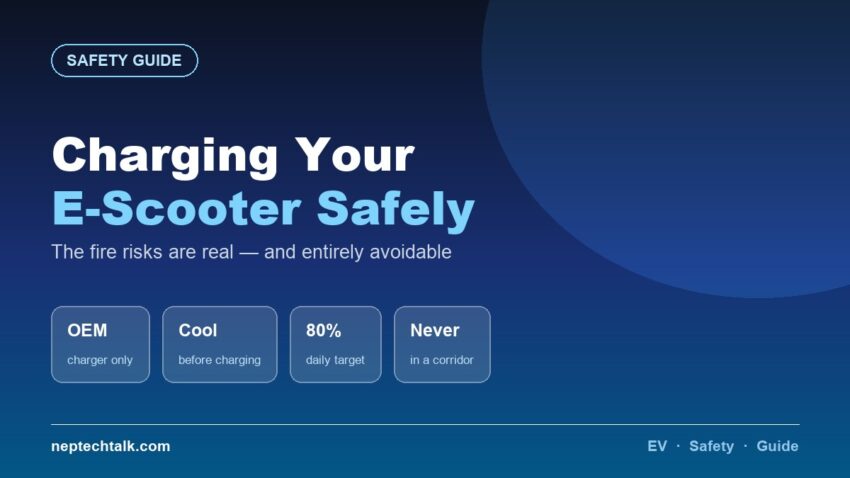
1. Use only the manufacturer’s charger. This is the single most important rule. A charger designed for a different battery chemistry or voltage is a genuine fire risk, and using non-approved equipment also voids your battery warranty on most vehicles.
2. Never charge in an escape route. Do not charge in a corridor, stairwell or doorway. In the rare event of a battery fire, that is the path you need to leave by. This is standard guidance worldwide and it applies fully in Nepali apartment buildings.
3. Let the battery cool before charging. After a hard ride, especially a long climb in summer, the pack is hot. Charging a hot battery accelerates degradation and increases risk. Wait.
4. Charge where there is ventilation and a working smoke alarm.
5. Do not charge unattended overnight while you sleep, if you can avoid it. Charging during waking hours is safer.
6. Do not cover the charger or the battery while charging. Both need airflow.
7. Stop immediately if anything is abnormal — a swollen battery, unusual heat, a smell, or any deformation. Disconnect, move the battery outdoors if it is safe to do so, and contact the dealer.
A swollen battery is a warning, not an inconvenience. Do not press it, puncture it, or continue using it.
The electrical setup
For most electric scooters, a standard household socket is adequate — unlike electric cars, which need a dedicated wall charger.
But the socket must be sound:
- A socket in good condition, not loose or worn
- Correct earthing — have it tested rather than assumed. Older Nepali wiring is a common weak point.
- Not sharing an extension lead with other high-draw devices
- A good-quality extension lead if you must use one, fully unwound — a coiled lead under load generates heat
- Surge protection where power quality is unreliable
If the socket or plug gets warm during charging, stop and have the wiring checked. That is not normal.
Removable versus fixed batteries
Removable batteries are a genuine advantage in Nepali apartments.
- Carry the battery inside and charge it in your flat
- No need for building permission or a dedicated parking point
- Charge in a room, not a corridor — the escape route rule applies indoors too
- Carry it carefully; these packs are heavy and dropping one can damage the cells
Fixed batteries require parking with a power point, which means building permission in most apartment situations. Establish this before buying the scooter — it is the most common reason an EV purchase becomes frustrating.
Habits that extend battery life
The charging routine determines how much capacity remains in year three, and battery replacement cost is the main financial risk in electric scooter ownership.
- Charge to 80% for daily use, 100% only before a long ride. The single most effective habit.
- Avoid running to near zero repeatedly
- Do not leave it at 100% or near 0% for extended periods — if storing the scooter, leave the battery around half charged
- Charge in moderate temperature. Not in direct sun, not in freezing conditions.
- Let it cool after riding before plugging in
- Use the manufacturer’s charger — again, because it matters most
A well-treated battery retains meaningfully more capacity at year three than a badly treated one of the same model. Our range guide covers why you should size your purchase for the range you will have in year three, not on delivery day.
Monsoon and dust
- Never charge a wet battery or connector. Dry both completely first.
- Keep the charging port clean — dust in the connector causes poor contact and heat
- Do not charge outdoors in rain, even under a partial cover
- Check the connector periodically for corrosion or damage
Frequently asked questions
Can I charge an electric scooter from a normal socket in Nepal? Generally yes, provided the socket is sound, correctly earthed and not shared with other high-draw devices.
Is it safe to charge overnight? Charging during waking hours is safer. If you do charge overnight, do it in a ventilated space with a working smoke alarm, never in an escape route.
Can I charge the battery inside my flat? With a removable battery, yes — in a room, not a corridor or stairwell.
What if the battery is swollen? Stop using it immediately. Do not press or puncture it. Contact the dealer and dispose of it through them, never in general rubbish.
What charge level is best for daily use? 80%. Charge to 100% only before a long ride.
The bottom line
Charging an electric scooter at home in Nepal is safe with four rules: the manufacturer’s charger only, a sound and earthed socket, never in an escape route, and let the battery cool after riding first. Then charge to 80% daily and keep it out of extreme heat — those habits are what still has range in year three.