Checked August 2026. Both operators change pack pricing frequently — always verify in the app before buying; treat examples here as illustrative.
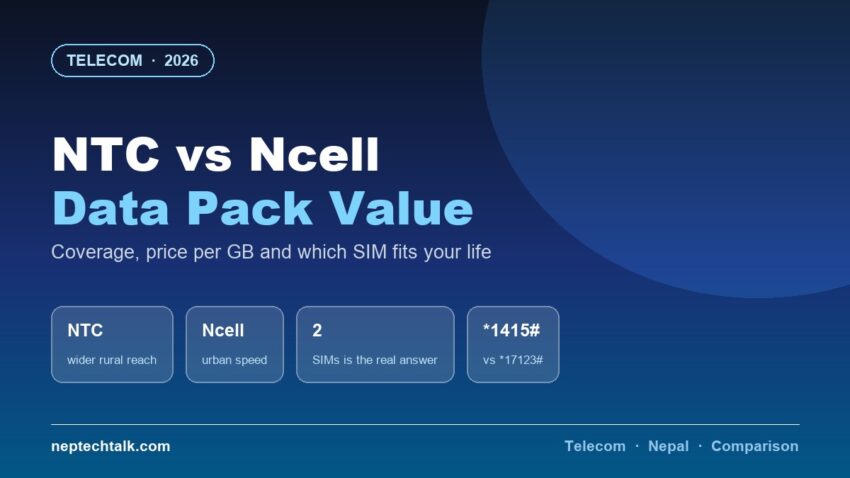
The NTC vs Ncell data pack debate is Nepal’s longest-running tech argument, and the honest answer depends on exactly two things: where you spend your time, and what you use data for. Here is the framework that actually settles it.
The one-table answer
| Factor | NTC (Nepal Telecom) | Ncell |
|---|---|---|
| Rural and highway coverage | Stronger — the state network reaches further | Concentrated on cities and corridors |
| Urban 4G speed | Good | Often faster in core city areas |
| Data pack pricing | Competitive, frequent offers | Competitive, aggressive social packs |
| Voice within Nepal | Cheap on-net, wide reach | Cheap on-net |
| Pack discovery | NT app / \*1415# | Ncell app / \*17123# |
| Best for | Travellers, rural users, one-SIM users | Urban heavy-data users |
How to actually compare value
Never compare headline prices — compare rupees per GB per day of validity, on the pack sizes you actually finish. A big cheap pack you never finish is expensive; a small pack you refill thrice is too.
Method that takes two minutes:
- Open both apps (NT app and Ncell app) — packs there are current, and app-only offers are common.
- Find each operator’s pack closest to your monthly usage (check your phone’s data counter for the real number).
- Divide price by GB. Compare like with like — 28-day against 28-day.
- Check the social-media inclusion: both operators sell packs where TikTok/YouTube/Facebook data is bundled separately from open data. If most of your usage is one app, these bundles beat general packs badly.
The coverage truth
City-dwellers can pick either. Everyone else should let geography decide:
- NTC carries further into hills, rural districts and highway stretches. If your life includes bus routes, village visits or trekking-adjacent travel, NTC on at least one SIM is close to mandatory.
- Ncell typically delivers its best speeds in Kathmandu valley, Pokhara and major towns — where its users mostly are.
The pattern most Nepalis have already converged on is the right one: dual SIM, one of each, with data on whichever is stronger where you currently stand.
Voice, validity and the small print
- On-net vs off-net: calls within the same network stay cheaper; if your family is all-NTC, that decides your voice SIM regardless of data.
- Validity games: the cheapest per-GB packs are often night packs or short-validity packs. They are only value if your usage actually fits those hours.
- Auto-renewal: both operators auto-renew some packs; know how to disable it in-app to avoid balance drain.
- Student/youth offers: both run targeted offers (campus packs, app-specific bundles) that beat public pricing — worth checking eligibility.
Frequently asked questions
Which is cheaper, NTC or Ncell data packs? It alternates offer to offer. Compare rupees-per-GB in both apps on the day, at your real usage size — that comparison, not brand loyalty, is the answer.
Which SIM has better coverage in Nepal? NTC reaches further outside cities; Ncell is strong in urban cores. For travel across Nepal, NTC; for city-only life, either.
How do I check data packs on each network? NTC: the Nepal Telecom app or \1415#. Ncell: the Ncell app or \17123#. App prices are the current ones.
Are social media packs worth it? If one app dominates your usage, yes — bundled TikTok/YouTube data is routinely the cheapest data either operator sells. If your usage is spread out, buy open data.
Should I keep both SIMs? Yes — it is the cheapest insurance in Nepali telecom. One slot each, data on whichever is stronger locally, voice on whichever your family uses.
The bottom line
NTC wins geography, Ncell often wins urban speed, and value flips with every offer cycle — so the durable strategy is dual-SIM, app-checked packs, compared per GB on your real usage. That framework outlives any specific pack price, including the ones current when this was checked in August 2026.