Checked August 2026. Confirm current prices and variants at the dealership.
With fuel a permanent household expense in Nepal, mileage is the number most bike buyers actually care about. The best mileage bike in Nepal is easy to identify by category — and easier still to ruin through habits.
Realistic mileage by engine size
| Engine | Claimed kmpl | Realistic city | Realistic highway |
|---|---|---|---|
| 100–110cc | 70–85 | 55–65 | 65–75 |
| 125cc | 60–70 | 50–58 | 58–68 |
| 150cc | 45–55 | 38–45 | 45–52 |
| 160–200cc | 40–45 | 32–40 | 40–45 |
| 250cc+ | 30–38 | 26–33 | 33–38 |
Expect roughly 80–85% of the claimed figure in real riding, and less in dense city traffic.
The answer, plainly
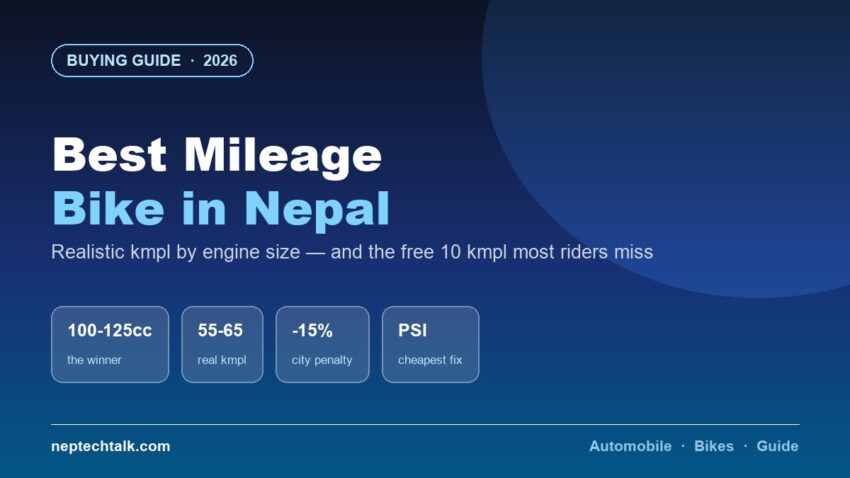
100–125cc commuter motorcycles deliver the best mileage in Nepal, and by a wide margin. If fuel economy is your primary criterion, the decision is made at the engine-size stage; the badge matters far less.
Why the smaller engines win so decisively: less mass to move, lower displacement, and gearing tuned for efficiency rather than acceleration. There is no 200cc bike that competes on mileage with a well-maintained 110cc commuter.
The trade-off is honest: less power for highway overtaking, less comfort at sustained speed, and more strain carrying a pillion on steep gradients.
Choosing between them
Within the 100–125cc commuter class, mileage differences between brands are modest. The decisive factors are the same ones that decide any Nepali two-wheeler purchase:
- Service network reach — parts in a day, not a week
- Resale value — the established commuter names hold value best
- Spare parts cost and availability
- Seat comfort for your actual daily distance
- Suspension — Nepali roads punish cheap setups
Buy the commuter bike with the best service access near you. The mileage difference between contenders is smaller than the cost of a week off the road.
The free 10 kmpl most riders leave on the table
Riding habits and maintenance affect mileage more than the choice between two similar bikes.
- Tyre pressure, checked fortnightly. Under-inflated tyres cost 5–10% mileage. This is free.
- Regular servicing at the recommended interval. A clogged air filter or fouled plug costs real fuel.
- Smooth acceleration. Hard throttle between traffic lights is where mileage disappears in city riding.
- Correct gear selection — labouring in too high a gear, or revving in too low a gear, both waste fuel.
- Chain tension and lubrication — a dry, slack chain wastes power directly.
- Do not idle at long stops.
- Remove unnecessary weight and accessories.
A well-maintained bike ridden smoothly will beat a neglected one of the same model by 10 kmpl or more. That gap is larger than any difference between competing models.
City versus highway
City riding costs roughly 15% mileage compared with steady highway running — constant stopping, idling, and short trips where the engine never fully warms.
If your riding is almost entirely urban and short-distance, consider whether an electric scooter fits. Running costs are dramatically lower, and city speeds suit the range. Our running-cost comparison covers the arithmetic; the constraints are charging access and service reach.
Buying checks
- Test ride with your normal load, including a pillion
- Confirm the nearest service centre and parts availability
- Ask about service costs, not just purchase price
- Get finance terms in writing if buying on EMI — see hire purchase rules
- Insurance quote before purchase — our insurance guide covers what to check
- Bluebook and registration timeline from the dealer
Frequently asked questions
What is the best mileage bike in Nepal? A 100–125cc commuter motorcycle, delivering a realistic 50–65 kmpl. Choose between them on service network, not on claimed mileage.
What mileage will I actually get? Roughly 80–85% of the claimed figure, and less in dense city traffic.
Is a 150cc bike much worse on fuel? Yes — typically 38–45 kmpl against 55–65 for a 110cc. You are paying for power you may not need.
How can I improve my bike’s mileage? Correct tyre pressure, regular servicing, smooth throttle and a properly lubricated chain. These are worth more than switching models.
Should I consider electric instead? For short urban commuting with home charging and nearby service, seriously yes. Running costs are far lower.
The bottom line
The best mileage bike in Nepal is a 100–125cc commuter from whichever brand services your area properly — expect 55–65 kmpl in the city, not the 80 on the brochure. Then take the free 10 kmpl: correct tyre pressure, regular service, smooth throttle. That habit gap is bigger than any gap between models.