Updated August 2026
The question comes up in every conversation about AI in Nepal, and it usually gets one of two useless answers: dismissive reassurance, or apocalyptic warning. The honest position on AI taking jobs in Nepal is more specific than either — and more actionable.
The framing that actually helps
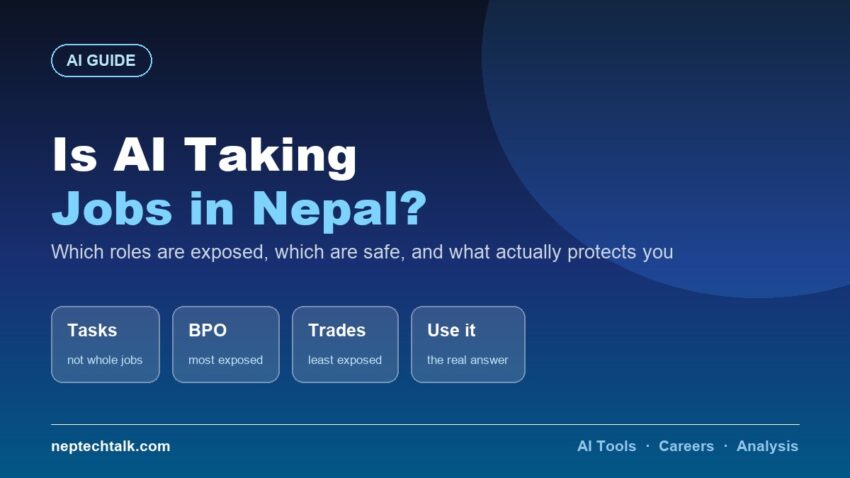
AI automates tasks, not jobs.
Most jobs are bundles of many tasks. AI is very good at some of them and useless at others. A job disappears only when most of its tasks are automatable — which is rarer than the headlines suggest.
The realistic pattern is displacement within roles, not elimination of them. The person who does the job changes what they spend their day doing.
Which Nepali roles are most exposed
| Exposure | Roles | Why |
|---|---|---|
| High | Basic content writing, simple data entry, routine translation, template design, first-line support scripts | Highly repetitive, text-based, well-defined |
| Medium | Junior programming, bookkeeping, basic graphic design, routine research | AI does the first draft; human judgment still required |
| Low | Skilled trades, healthcare delivery, teaching, sales relationships, management, physical work | Requires presence, judgment, trust or hands |
Nepal’s BPO and outsourcing sector is the most genuinely exposed area, because the tasks it sells — data processing, basic content, routine support — are exactly what AI does cheaply.
That is not a prediction of collapse. It is a reason for that sector to move up the value chain, which some of it is already doing.
What is genuinely safe
Work requiring physical presence. Electricians, plumbers, mechanics, technicians, construction, agriculture. AI does not climb a pole or fix a motorcycle.
Work requiring trust and relationships. Sales, negotiation, management, counselling. People buy from and confide in people.
Work requiring local knowledge and judgment. Understanding Nepali regulation, markets, culture and context. AI models are weak here, and the gap is not closing fast.
Work requiring accountability. Someone has to be responsible for the decision. That someone is a person.
The honest risk
The real risk is not AI replacing you. It is a person using AI replacing you.
A designer using AI produces more than a designer who does not. A writer using AI drafts faster. A developer using AI ships more. Where two people compete for the same work, the one using the tools wins on output.
This is the actionable conclusion. The defence against AI is not avoiding it — it is being the person who uses it well.
What actually protects a career in Nepal
- Learn to use the tools properly. Not superficially — properly. Prompting, verification, and knowing what the tools do badly.
- Move up the value chain. Automate the routine part of your own job and spend the time on judgment, client relationships and quality.
- Build skills AI cannot replicate — physical, relational, accountable, locally-specific.
- Develop verification skill. As AI produces more output, the ability to check it becomes more valuable, not less. This is a genuinely growing skill category.
- Understand the local context deeply. It is where models are weakest and where Nepali professionals have a permanent advantage.
The opportunity side
AI also creates work in Nepal, and this gets less attention than it deserves:
- A one-person business can now do what previously needed a team. For Nepal’s large base of small entrepreneurs, this is genuinely enabling.
- The language barrier drops. Nepali professionals can compete for international work more easily.
- Training and implementation are themselves growing categories of work.
- Local businesses need people who understand these tools, and very few do.
Practical AI skill is currently scarce in Nepal. That scarcity is an opportunity for anyone who develops it now.
If you want structured training in Nepali, the AI Master Course covers practical use, prompting and verification. Our AI tools coverage is a free starting point.
Frequently asked questions
Is AI taking jobs in Nepal? It is automating tasks within jobs rather than eliminating roles wholesale. The BPO and routine content sectors are the most exposed.
Which jobs are safest? Skilled trades, healthcare, teaching, sales and management — anything requiring physical presence, trust, judgment or accountability.
Should I be worried? Be alert rather than worried. The realistic risk is being outcompeted by someone using AI, not replaced by AI directly.
What should I do about it? Learn the tools properly, automate the routine parts of your own work, and build verification skill. That is the whole answer.
Does AI create jobs in Nepal too? Yes — practical AI skill is currently scarce here, and small businesses gain capability they never had. That is a real opportunity.
The bottom line
AI is taking tasks in Nepal, not jobs — and the person most at risk is not the one competing with AI, but the one competing with a colleague who uses it. Learn the tools, verify their output, and move your time towards the judgment and relationships no model can supply. That is the defence, and it is also the opportunity.