Checked August 2026. Verify current pricing before buying.
A student phone has a specific job: survive several years of heavy use on a limited budget. The best phone for students in Nepal is chosen on different priorities from a general buying guide — and cameras are not near the top.
The priority order
| Priority | Why it matters for a student | |
|---|---|---|
| 1 | Battery life | Long days away from a charger |
| 2 | Durability and a case | It will be dropped |
| 3 | RAM | It needs to stay fast for three or four years |
| 4 | Storage | Notes, photos, downloaded lectures |
| 5 | Software update commitment | Security matters over a long ownership |
| 6 | Camera | Useful, not decisive |
| 7 | Gaming performance | Genuinely optional |
The budget
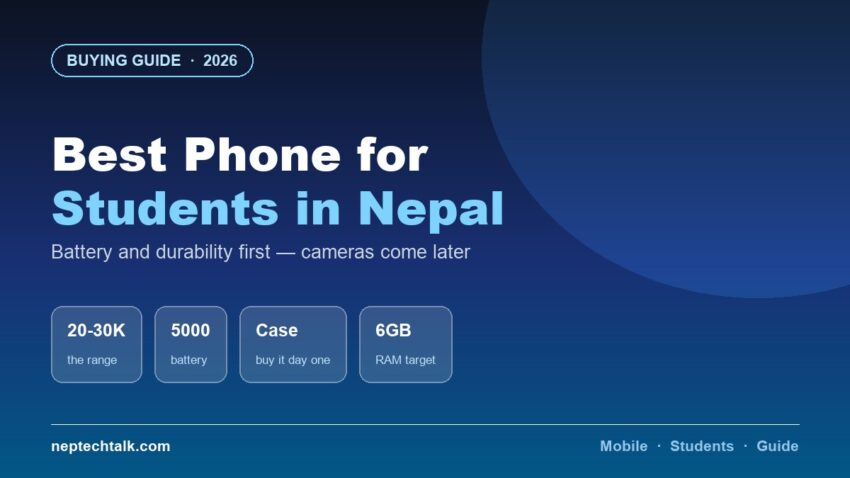
NPR 20,000–30,000 is the sensible student range.
At NPR 20,000: a 5,000mAh battery, 4–6GB RAM and 128GB storage. Workable, and the big-battery guide for this band covers what to look for.
At NPR 25,000: 6GB RAM becomes standard and the chipset improves meaningfully. This is the better value point if the budget stretches.
At NPR 30,000: 8GB RAM, better display, faster charging, sometimes ingress protection. The value peak of the market for general use.
Below NPR 20,000, compromises start affecting daily use within a year.
What actually matters, in detail
1. Battery — 5,000mAh minimum. Long days at college, unreliable access to charging, and years of use ahead. Chipset efficiency matters as much as capacity — our big-battery explainer covers why a well-optimised 5,000mAh phone can outlast a poorly optimised 6,000mAh one.
2. RAM — 6GB, ideally 8GB. This is the specification that determines whether the phone is still usable in year three. For a student keeping a phone through a degree, it is the most consequential choice on the list. Do not accept 4GB if 6GB is affordable.
3. Storage — 128GB minimum. Notes, photos of whiteboards, downloaded lectures and course material accumulate. Our storage explainer covers why you should keep 15–20% free, so treat 128GB as roughly 90GB of real capacity.
4. A case and tempered glass, bought on day one. This is not optional for a student phone. Our cases and protectors guide explains that a case with raised edges plus tempered glass costs a fraction of a screen repair and prevents most of the damage. Buy both with the phone, not after the first drop.
5. Software update commitment. Ask how many years of security updates the specific model gets. Over a four-year degree, this matters.
What to skip
- High-end cameras. Every phone at this price photographs adequately in daylight, which covers most student use.
- Gaming performance. If gaming is a priority, that is a different purchase — see our gaming guide. For studying, it is not.
- 5G, if it costs you RAM or battery. Our 5G guide for this band covers when to take it and when not to.
- Very fast charging. 18–33W is fine.
- Premium build materials. A case covers them anyway.
Buying checks
The same checks apply as at any price:
- Dial \*#06# for the IMEI and verify it against the MDMS registry
- Warranty on the bill with the seller’s stamp
- Confirm the exact variant — RAM and storage vary between configurations
- Test everything in the shop — both SIM slots, cameras, speakers, charging port
- Ask for the update commitment in years
Should a student buy used?
Sometimes, and carefully. Our second-hand buying guide covers the ten-minute inspection that prevents an expensive mistake.
But compare honestly: a new phone at NPR 20,000 comes with a full warranty and a fresh battery. A used mid-range phone at the same price may have neither. For a student who cannot easily absorb a repair cost, the new phone is often the safer purchase.
Frequently asked questions
What is the best phone for a student in Nepal? One with a 5,000mAh battery, 6GB RAM and 128GB storage in the NPR 20,000–30,000 range — plus a case and tempered glass bought on day one.
How much should a student spend? NPR 20,000–30,000. Around 25,000 is the value point where RAM and chipset quality improve meaningfully.
Is 4GB RAM enough? Not for a phone you will keep three or four years. Take 6GB if it is affordable.
Do I need a good camera? Every phone at this price handles daylight photography adequately. Prioritise battery and RAM instead.
Should I buy used to get a better phone? Compare carefully — a new phone with a warranty and fresh battery is often safer for someone who cannot absorb a repair bill.
The bottom line
The best phone for students in Nepal has a 5,000mAh battery, 6GB of RAM and 128GB of storage, and costs NPR 20,000–30,000. Buy the case and tempered glass on the same day — that is the cheapest insurance a student phone will ever get. And take RAM over cameras, because RAM is what keeps the phone usable until you graduate.