Updated August 2026. This is general guidance — always follow your specific vehicle’s manual and manufacturer instructions.
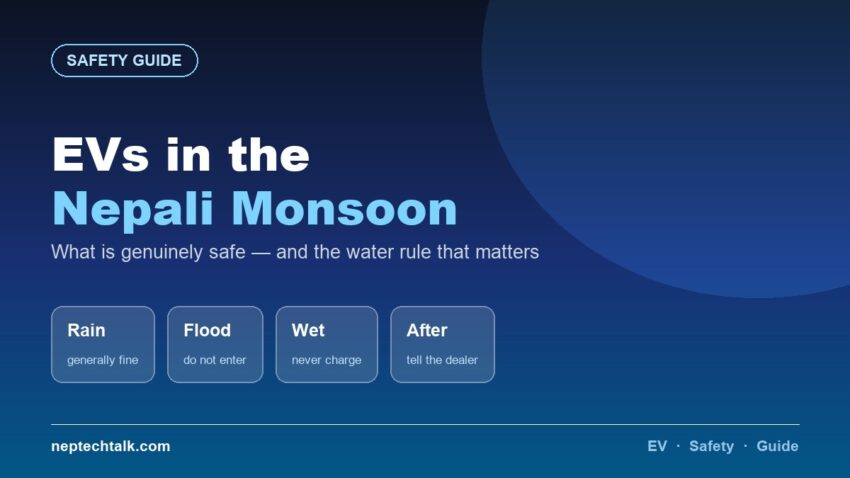
Nepal’s monsoon runs for months, and the most common question from new electric vehicle owners is whether rain and high-voltage batteries are a problem. The honest answer is that ordinary rain is not, and standing water is.
Rain is not the problem
Electric vehicles are designed and certified to operate in rain.
The high-voltage system is sealed, and manufacturers test for water exposure. Riding or driving in rain is entirely normal and safe on a properly maintained vehicle.
The concerns are specific and manageable:
| Situation | Reality |
|---|---|
| Riding in rain | Fine |
| Parking in rain | Fine |
| Washing the vehicle | Fine, following the manual |
| Driving through standing water | The actual risk |
| Charging while wet | Never do this |
| Full submersion | Serious — treat as a safety incident |
The water depth rule
Do not drive or ride through standing water of uncertain depth.
This applies to every vehicle, but it matters more for an EV because water ingress into the battery pack or high-voltage components is a serious and expensive failure, not merely an inconvenience.
In practice during a Nepali monsoon:
- If you cannot see the road surface, do not enter the water
- Turn around rather than risk it. A flooded underpass or street is not worth a battery pack.
- Be especially careful of water flowing across a road — depth and force are both unpredictable
- After heavy rain, expect surfaces to have changed — potholes hidden by water are a hazard in themselves
Our hill range guide covers terrain; this is the other Nepali condition that genuinely constrains EV use.
Charging in monsoon — the real rules
This is where genuine care is required.
- Never charge a wet vehicle or connector. Dry both completely first.
- Never charge outdoors in rain, even under partial cover
- Keep the charging port clean and dry. Dust and moisture in the connector cause poor contact and heat.
- Inspect the cable and connector periodically for damage or corrosion
- For electric scooters with removable batteries, dry the battery and contacts before charging indoors
- Ensure your charging point has proper earthing and residual current protection — our home charger guide covers the installation requirements
Charging a wet connector is the one genuinely dangerous thing an EV owner can do in monsoon, and it is entirely avoidable.
If the vehicle has been in deep water
Treat this as a safety incident, not a car problem.
- Do not attempt to charge it
- Do not attempt to drive it further than absolutely necessary to reach safety
- Contact the dealer or manufacturer immediately and describe exactly what happened
- Tell your insurer, and photograph everything before anything is moved
- Do not let a general workshop investigate a high-voltage system after water exposure
Our EV insurance guide covers why you should already know whether flood damage to the traction battery is covered by your policy — it is one of the questions to get in writing before purchase.
Ordinary monsoon maintenance
- Brakes. As our maintenance guide notes, regenerative braking means EV brakes are used less — and rarely-used brakes can seize or corrode in humidity. Have them inspected during monsoon even though they wear slowly.
- Cabin air filter — humidity and dust together clog it faster
- Tyres — check tread depth. Wet grip depends on it, and EVs are heavy with instant torque.
- Wash off mud promptly, particularly around the underbody
- Check the charging port for debris regularly
For riders specifically
On an electric scooter:
- Wet grip matters more than power. Ride accordingly — instant torque on a wet road is a hazard.
- Regenerative braking behaves differently in the wet — be smooth with it
- Waterproof your phone if it is mounted — our IP rating explainer covers why the rating on the box does not mean warranty coverage
- Dry the battery contacts before charging
- Store the scooter under cover where possible
Frequently asked questions
Is it safe to ride an EV in the rain? Yes. EVs are designed and certified for rain. Ordinary wet-weather riding and driving is entirely normal.
Can I drive an EV through flood water? No. Do not enter standing water of uncertain depth — water ingress into the battery or high-voltage components is a serious failure.
Can I charge in the rain? No. Never charge a wet vehicle or connector, and never charge outdoors in rain.
What if my EV has been in deep water? Do not charge or drive it. Contact the dealer immediately, tell your insurer, and do not let a general workshop investigate the high-voltage system.
Does monsoon affect EV maintenance? Have the brakes inspected — regenerative braking means they are used less, and rarely-used brakes can seize or corrode in humidity.
The bottom line
Riding an EV in Nepal’s monsoon is safe: the vehicles are built for rain. Two rules matter — never enter standing water of uncertain depth, and never charge a wet vehicle or connector. If it has been through deep water, do not charge it or drive it; call the dealer. And have the brakes checked, because on an EV they rust from disuse rather than wearing out.