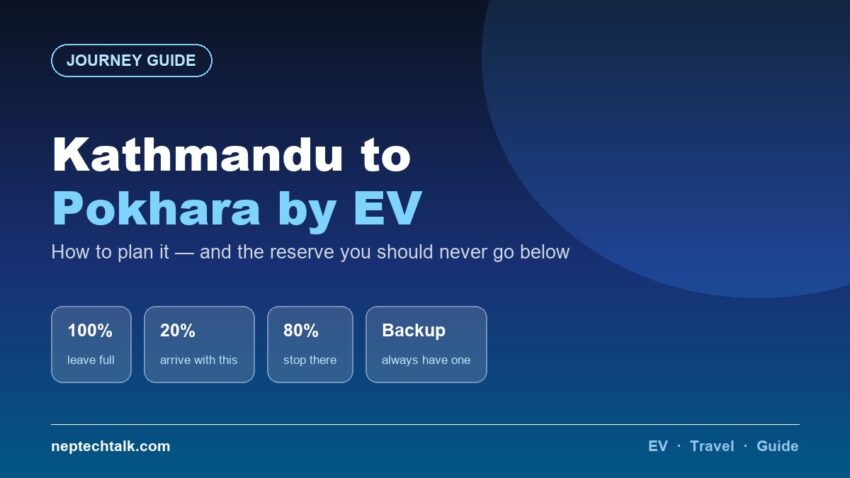
Updated August 2026. Charging infrastructure changes rapidly — verify current charger locations and status through your vehicle’s app, your dealer, or the charging network before travelling.
The Kathmandu–Pokhara run is the journey most Nepali EV owners ask about. The short answer is yes, it is doable — and the planning that makes it comfortable is straightforward.
The four rules
| Rule | Why |
|---|---|
| Leave with 100% | Never start a long hill journey at 70% |
| Plan to arrive with 20% | Reserve absorbs diversions and closed chargers |
| Confirm destination charging before departing | Not en route |
| Never depend on one specific charger | A single out-of-service unit changes everything |
The fourth rule is the one people learn the hard way. Identify a backup before you need it.
What actually consumes your range
Speed matters more than hills. This surprises most drivers.
At highway speeds, aerodynamic drag rises sharply — reducing your cruising speed by 15 km/h can recover more range than avoiding a climb. Many drivers blame terrain for consumption that is actually caused by driving at 100 km/h.
Terrain costs less than you expect. Our hill range analysis covers the arithmetic: a climb consumes roughly 40% more than flat driving, but regenerative braking recovers a meaningful share on the descent. Net penalty on a round trip is roughly 20%, not 40%.
Other factors:
- Air conditioning — real, especially in Terai heat, but less than most people fear
- Load — passengers and luggage, in proportion to weight
- Cold — 10–20% on winter mountain mornings; pre-condition while plugged in
Planning the journey
1. Start from your real range, not the brochure figure.
Take your vehicle’s realistic range in current conditions — which your car’s own consumption history will tell you more accurately than any specification — and derate it for hills and load.
2. Identify charging options along the corridor and at your destination.
Infrastructure along the main highway has improved substantially. Verify current status — through your vehicle’s app, the charging network, or by calling ahead.
3. Confirm your connector type matches. Arriving at a charger you cannot physically use is the most common EV frustration.
4. Identify a backup at each point.
5. Plan your stops around meals and rest, which you would take anyway. A charging stop that coincides with lunch costs you no extra time.
Charging on the road
Stop at 80%, not 100%.
DC fast charging slows substantially above 80% by design, to protect the battery. Charging from 20% to 80% is efficient; the last 20% takes disproportionately long.
On a journey, two shorter stops beat one long one.
Charging speed also depends on:
- Your vehicle’s maximum accepted rate — a fast charger cannot exceed what your car will take
- Battery temperature — a cold or very hot pack charges more slowly
- How full the battery already is
- Whether other vehicles are sharing the station’s capacity
Charging etiquette
Nepal’s network is small enough that behaviour matters:
- Move your vehicle when charging completes — a finished car blocking a charger delays everyone
- Do not unplug someone else’s vehicle
- Do not use a charging bay for ordinary parking
- Report faulty units so they get fixed
Is an EV practical as a sole vehicle?
Within the Valley and along the main corridors: comfortably yes, provided you have home charging, which should do 80% of your charging.
For frequent travel to remote districts: plan carefully. Charging outside the corridors remains thin, and a hill route with no charger at the far end is a genuine constraint.
For a household with a second petrol vehicle: entirely practical, and the running-cost saving is substantial.
Frequently asked questions
Can I drive Kathmandu to Pokhara in an EV? Yes — leave with a full charge, drive at moderate speed, and confirm charging at your destination before departing.
How much reserve should I plan for? Arrive with 20% or more. Reserve is what lets you handle a diversion or a closed charger.
Do the hills ruin EV range? Less than expected — climbing costs about 40% more, but regenerative braking recovers much of it on the descent, netting around 20% on a round trip.
Should I charge to 100% on the road? No. Stop at 80% and continue — charging above that is disproportionately slow by design.
What costs more range, hills or speed? Speed, on highways. Reducing your cruising speed recovers more range than avoiding a climb.
The bottom line
Kathmandu to Pokhara in an EV is entirely doable: leave full, drive moderately, stop at 80%, and plan to arrive with 20% in reserve. Confirm your destination charger before you leave and identify a backup at each stop — because the only journeys that go wrong are the ones that depended on a single charger working.