Updated August 2026
Every electric scooter sold in Nepal advertises a range figure, and almost nobody achieves it. That is not fraud — it is a test-condition number being read as a real-world promise. Here is what electric scooter range in Nepal actually looks like, and how to size a purchase honestly.
The headline number
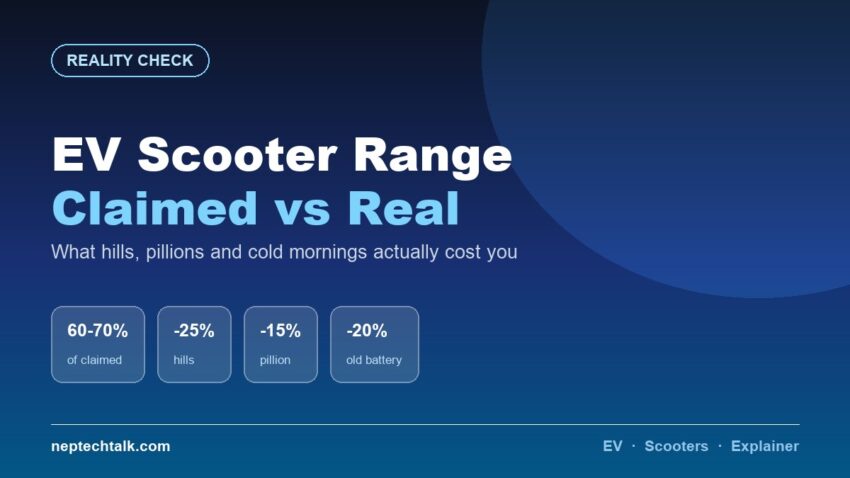
Expect 60–70% of the claimed range in normal Nepali use.
| Claimed | Realistic flat-ground | Realistic hilly, with pillion |
|---|---|---|
| 60 km | 40–45 km | 30–36 km |
| 80 km | 52–58 km | 40–48 km |
| 100 km | 65–75 km | 48–60 km |
| 120 km | 78–88 km | 58–72 km |
Why claimed figures are so optimistic
Manufacturers test under conditions designed to produce the largest possible number:
- Flat ground, no gradients
- Constant low speed, often 25–30 km/h
- A light rider, no pillion, no cargo
- A new battery at full health
- Moderate temperature
- Eco mode, minimal acceleration
None of those describe a Kathmandu commute.
What each factor actually costs
Hills — the biggest single factor, roughly 20–30%. Climbing consumes energy in direct proportion to gradient and weight. Kathmandu’s ring road is manageable; the climbs to Kirtipur, Budhanilkantha or anywhere in Pokhara’s hill approaches are not.
The offset most people miss: regenerative braking recovers a meaningful share on the way down. A round trip up and back costs less than twice the climb. Net penalty on a hilly round trip is typically 15–25%, not 30%.
A pillion — roughly 10–20%. Weight is the second-biggest variable.
Speed — significant. Riding at 50 km/h consumes far more energy per kilometre than 30 km/h. Aerodynamic drag rises sharply with speed.
Cold — roughly 10–20% in a Kathmandu winter morning. Lithium batteries deliver less in cold. Range recovers as the day warms.
Battery age — up to 20% by year three or four. Every battery degrades. Size your purchase for the range you will need in year three, not on delivery day.
Riding style. Hard acceleration from every stop is the fastest way to empty a battery.
How to size your purchase honestly
Take your longest regular round trip. Double it. Buy a scooter claiming at least that.
Example: a 20 km each-way commute is 40 km round trip. Double it to 80 km. Buy a scooter claiming at least 80 km, and you will comfortably complete the trip in year three, on a hill, with a pillion, in winter.
This sounds excessive. It is not. Range anxiety is what makes people stop using an electric scooter, and the margin is what prevents it.
Extending real range
- Correct tyre pressure — the cheapest range improvement available, checked fortnightly
- Smooth acceleration — the single largest rider-controlled factor
- Eco mode for commuting, full power when you need it
- Moderate speed — 40 km/h is dramatically more efficient than 55 km/h
- Charge to 80% for daily use, 100% only before a long trip — this also extends battery life
- Avoid charging immediately after a hard ride while the battery is hot
The honest comparison
Our running cost analysis shows electric scooters win decisively on cost per kilometre. Range is the trade-off you are accepting in exchange.
For city commuting, range is a solved problem — even conservatively derated, any credible modern scooter covers a normal Nepali commute. For long-distance intercity riding, it is not, and a petrol scooter remains the practical choice.
Be honest about which one you are. Most buyers are commuters who occasionally imagine long trips.
Frequently asked questions
What real range do electric scooters give in Nepal? Roughly 60–70% of the claimed figure on flat ground, and less on hills with a pillion.
How much range do hills cost? Roughly 20–30% climbing, though regenerative braking recovers a share on descent — netting 15–25% on a round trip.
Does range drop in winter? Yes, typically 10–20% on cold mornings, recovering as the day warms.
How much range should I buy? Take your longest regular round trip and double it. That margin covers hills, pillion, cold and battery ageing.
Does the battery lose range over time? Yes — expect up to 20% degradation by year three or four. Size your purchase accordingly.
The bottom line
Electric scooter range in Nepal is 60–70% of the claimed number, less on hills, less again with a pillion in winter on an ageing battery. Size for double your longest regular round trip, keep the tyres correct and the throttle smooth, and range stops being something you think about.