Updated August 2026
Nepal is one of the most demanding EV environments on earth — sustained climbs, sharp descents and long distances between charging points. The good news is that EV range on Nepal’s hills behaves more predictably than most buyers fear, once you understand what is actually happening.
The physics, briefly
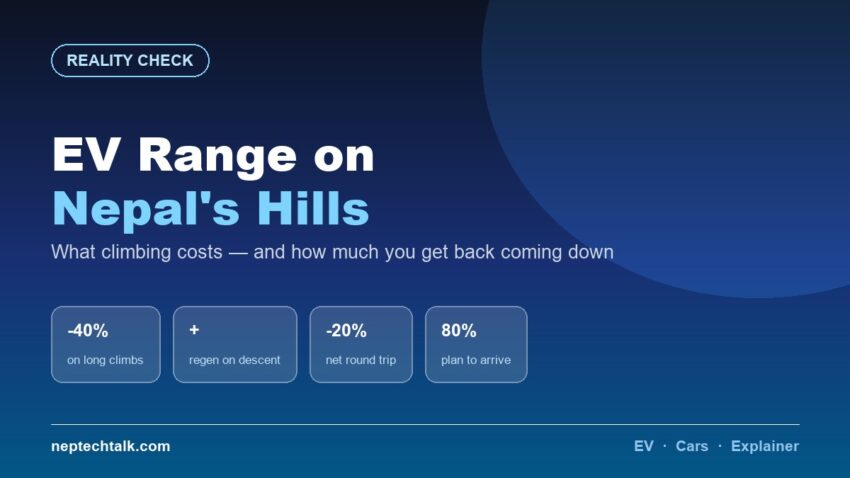
Climbing a hill means lifting the vehicle’s mass against gravity, and that energy has to come from the battery. On a sustained climb, consumption can rise by 40% or more over flat-ground driving.
But here is what makes EVs different from petrol cars on hills: on the descent, regenerative braking converts a meaningful share of that potential energy back into the battery. A petrol car turns it all into brake heat.
What a real journey looks like
| Segment | Consumption |
|---|---|
| Flat highway, steady speed | Baseline |
| Sustained climb | 40%+ above baseline |
| Sustained descent | Well below baseline, often recovering charge |
| Round trip, hills, net | Roughly 20% above flat-ground equivalent |
This is the number that matters. A round trip into the hills and back costs roughly 20% more range than the same distance on flat ground — not the 40% the climb alone suggests.
A one-way climb is different. Driving to a hill station and staying overnight means you absorb the full climbing penalty with no descent to recover it. Plan those journeys with real margin.
The Kathmandu–Pokhara question
The most common real-world planning question for Nepali EV owners.
The honest guidance:
- Leave with a full charge. Do not start a long hill journey at 70%.
- Plan to arrive with 20% or more. Reserve is not waste; it is what lets you handle a diversion or a closed charger.
- Confirm charging availability at your destination before departing — not en route.
- Check charger status along the corridor. Infrastructure along the main highways has improved substantially, but a single out-of-service charger changes your plan.
- Drive at moderate speed. At highway speeds, aerodynamic drag costs more range than the hills do.
Speed is the underrated factor. Many drivers blame hills for consumption that is actually caused by driving at 100 km/h. Reducing highway speed by 15 km/h can recover more range than avoiding a climb.
Other Nepali factors
Air conditioning costs range, meaningfully in Terai summer heat. Less than most people fear, but it is real.
Cold reduces battery output on winter mountain mornings, typically 10–20%. Pre-conditioning the cabin while still plugged in helps.
Traffic is where EVs win — stop-start Kathmandu traffic costs a petrol car dearly and an EV very little. Our running cost comparison reflects this.
Load. Passengers and luggage cost range in direct proportion to weight, and more so on climbs.
Practical habits
- Use regenerative braking properly. Lift off early and let regen slow the car rather than braking hard. This is the single largest driver-controlled factor on descents.
- Charge to 80% for daily use, 100% before long trips — better for battery longevity
- Pre-condition while plugged in on cold mornings
- Do not treat the range estimate as a promise — it is calculated from recent driving, and a flat-road estimate will fall fast on a climb
Is an EV practical as a sole vehicle in Nepal?
In and around the Kathmandu Valley and the main highway corridors: yes, comfortably.
For frequent travel to remote districts: plan carefully. Charging infrastructure outside the corridors remains thin, and a hill route with no charger at the far end is a genuine constraint.
For a household with a second petrol vehicle: entirely practical, and the running-cost savings are substantial.
Frequently asked questions
How much range do Nepal’s hills cost an EV? Roughly 40% extra consumption on the climb itself, but about 20% net on a round trip once regenerative braking recovers energy on the descent.
Can I drive Kathmandu to Pokhara in an EV? Yes, with a full charge, moderate speed, and confirmed charging at your destination. Plan to arrive with 20% reserve.
Does regenerative braking really help? Substantially on descents — it is the main reason EVs handle hills better than the climb figures suggest.
Does cold weather affect range? Yes, typically 10–20% on cold mountain mornings. Pre-condition while plugged in.
What costs more range, hills or speed? On highways, speed. Many drivers blame hills for consumption caused by driving fast.
The bottom line
EV range on Nepal’s hills costs roughly 20% net on a round trip — far less than the climb alone suggests, because regenerative braking gives much of it back. Leave full, drive moderately, plan to arrive with 20% in reserve, and confirm your destination charger before you leave. Do that and Nepal’s terrain stops being an obstacle.