Updated August 2026
It is one of the most common questions in a Nepali phone shop: the previous generation flagship sits at a substantial discount next to the new one. Whether last year’s flagship is the smart buy comes down to two factors, and price is not the more important of them.
The case for it
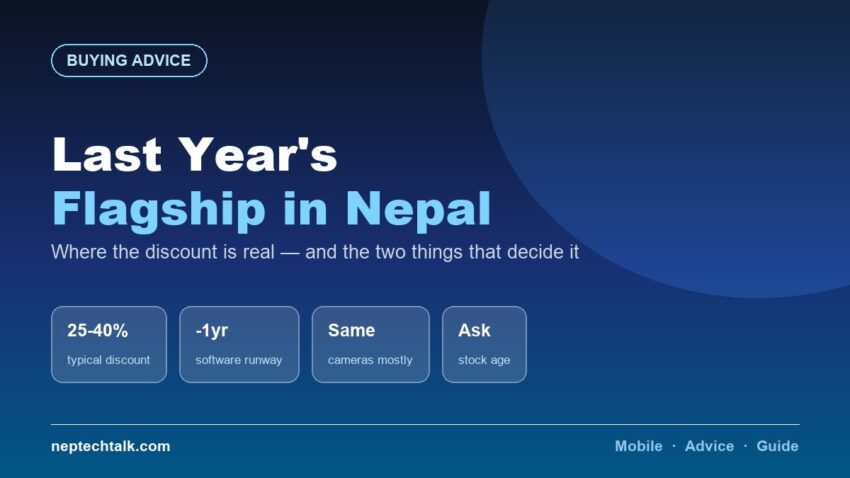
1. The discount is genuinely large. Previous-generation flagships typically sell at 25–40% below launch price once the successor arrives. That is real money.
2. The performance gap is small. Year-on-year flagship improvements have narrowed considerably. A one-year-old flagship chipset still outperforms nearly every current mid-range phone comfortably.
3. The cameras are largely the same. Most year-on-year camera improvements are software processing, and much of that arrives on the older phone through updates.
4. Build quality and display are unchanged. These do not degrade with a model year.
5. Accessories and cases are cheaper and more available.
The case against it
1. Software support runway is a year shorter. This is the most important argument. A phone with four years of support bought one year late gives you three. Ask specifically how many years remain, not how many the phone launched with.
2. Battery health. If the unit has been sitting in stock, the battery has aged even unused. Ask when the unit arrived.
3. Resale value falls faster as the model gets further from current.
4. You may miss a genuinely significant improvement. Most years bring incremental change, but occasionally a generation introduces something meaningful — a substantially better camera sensor, a major efficiency gain. Check what actually changed rather than assuming it was minor.
5. Stock availability and colour choice are limited.
The two questions that decide it
Question 1: How many years of software updates remain?
If the answer is three or more, the discount is excellent value. If it is one or two, you are buying a phone you will replace sooner than you think — and the discount is less generous than it appears.
Question 2: What actually changed in the new generation?
Read a genuine comparison, not the marketing. If the answer is “a slightly faster chip and marginally better processing”, buy the old one. If it is “a substantially better main sensor” or “a major battery efficiency improvement”, the premium may be justified.
The specific Nepal considerations
1. Confirm it is official stock, not grey market. Discounted previous-generation phones are exactly where grey-market imports appear. Dial \*#06#, check the IMEI against the MDMS registry, and insist on a warranty bill.
2. Ask when the unit arrived in Nepal. A phone that has sat in a warehouse for eighteen months has an aged battery and a shorter remaining warranty.
3. Confirm the warranty start date — is it from manufacture or from purchase? This matters more on older stock.
4. Check service parts availability for the older model.
5. Compare against current mid-range. Sometimes a current upper-mid phone at the same price is the better purchase — newer software runway, current battery, full warranty. Our buying guides cover the alternatives at every band.
The honest verdict
Buy last year’s flagship when: three or more years of software support remain, the generational change was incremental, it is verified official stock, and the discount is 25% or more.
Buy the current one when: the support runway is short, the new generation brought a genuine improvement you care about, or the discount is under 20%.
Buy a current mid-range instead when: the flagship discount still leaves it above a current upper-mid phone that does everything you actually need. This is more often the right answer than people expect.
Frequently asked questions
Is last year’s flagship a good buy in Nepal? Often yes, at a 25–40% discount — provided at least three years of software support remain and it is verified official stock.
How much discount should I expect? Typically 25–40% below launch price once the successor arrives.
What is the biggest downside? A shorter software support runway. Ask how many years remain, not how many it launched with.
How do I know it is not grey market? Check the IMEI via \*#06# against the MDMS registry and insist on a warranty bill with the seller’s stamp.
Should I buy a current mid-range instead? Sometimes — a current upper-mid phone offers a full software runway and fresh battery. Compare both at your actual budget.
The bottom line
Last year’s flagship in Nepal is usually good value, but the discount is not the deciding number — the remaining software support is. Ask how many years are left, ask what actually changed in the new generation, verify the IMEI, and ask when the unit landed in Nepal. Four questions, and they settle it.