Checked August 2026. Budget EV pricing and availability shift frequently — confirm on dated quotations.
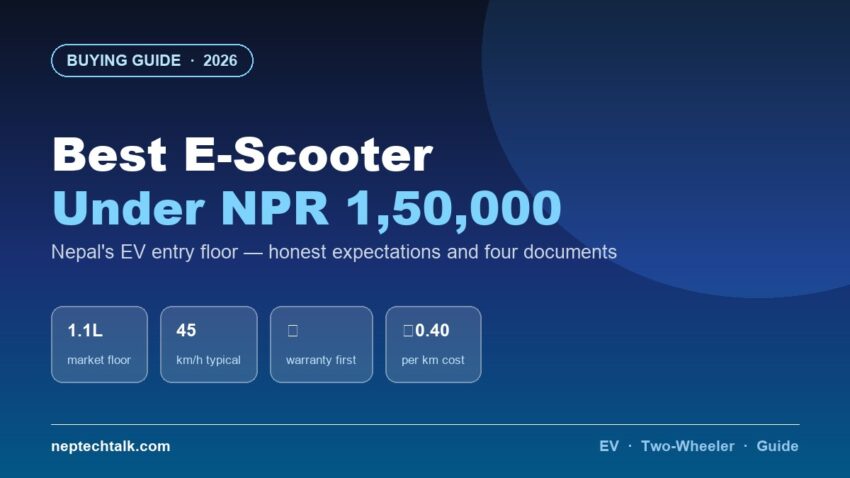
Nepal’s electric scooter market starts around NPR 1.1 lakh, which makes under 1,50,000 the true entry band. The best electric scooter under 1,50,000 in Nepal is a genuinely useful machine with limitations you must understand before buying.
What this budget realistically delivers
| Aspect | Reality under NPR 1,50,000 |
|---|---|
| Top speed | Typically 45–55 km/h — city only |
| Claimed range | 60–90 km; plan on 40–60 km real |
| Battery | Smaller packs; chemistry varies by model |
| Build | Lighter construction, basic components |
| Features | Minimal — LED lights, simple display |
| Charging | 4–8 hours typical |
The honest position: at this price you are buying city commuter transport, not a versatile vehicle. For a 15–20 km daily commute on valley roads, it works well. For hills, highways or pillion-heavy use, it does not.
Who this band actually suits
Good fit:
- Daily commutes under 25 km on relatively flat routes
- Second vehicle in a household that already has a motorcycle or car
- Students and young riders in valley towns
- Anyone whose alternative is a bicycle or public transport
Poor fit:
- Regular hill routes — range and power both suffer badly
- Frequent two-up riding
- Anyone without home or workplace charging access
- Riders who need to leave the city regularly
If your use is heavier, the NPR 2–3 lakh band — Yadea T9 at 2,35,000, TVS iQube 2.2 at 2,17,000, Yadea G6 at 2,60,000 — delivers substantially more capability, and the step is worth making if you can.
The four documents that decide the purchase
At this price the machines look similar and the paperwork differs. Before any deposit, get in writing:
1. Battery warranty — years, charge cycles, and the capacity-retention percentage that constitutes a valid claim. The battery is the largest share of a budget EV’s value; a vague warranty is a hidden cost.
2. The named service workshop in your town, with address. Then call it and ask whether controllers, chargers and battery modules are stocked in Nepal.
3. Printed spare-parts prices, today — charger, controller, brake set, battery module. These four numbers predict your five-year cost more accurately than any range claim.
4. Registration category for your exact model — bluebook, licence class and insurance requirements.
Dealers who answer all four confidently are worth buying from. Deflection on any of them is your answer.
The running-cost case
This is why the band exists at all. Home charging costs a few dozen rupees per full charge — under NPR 0.50 per kilometre against petrol’s multiples. On a 20 km daily commute, the monthly saving against a petrol scooter is real money.
The payback depends entirely on battery longevity — which is why the warranty paragraph above is the actual price tag. A budget EV whose battery fails in year three has cost more than the petrol scooter it replaced.
Frequently asked questions
What is the cheapest electric scooter in Nepal? The market floor sits around NPR 1.1 lakh. Availability at that price varies by brand and dealer — get current quotes.
Is an electric scooter under NPR 1,50,000 worth buying? For short flat city commutes with home charging, yes — the running-cost saving is genuine. For hills, highways or heavy use, step up to the 2–3 lakh band.
What real range should I expect? Plan on 40–60 km against 60–90 km claims, and less with a pillion or on inclines.
Do these need bluebook registration? Depends on the power class — get written confirmation for your specific model, as requirements differ.
Which brands compete here? Several budget-focused brands including Okaya, Ampere, Terra Motors, Green Tiger and others. The brand matters less than the four documents.
The bottom line
The best electric scooter under NPR 1,50,000 in Nepal is whichever dealer gives you a written battery warranty, a named local workshop, printed parts prices and a clear registration answer. At this price the machines are similar and the support is not. Set expectations at “city commuter”, get the four documents, and the running-cost maths does the rest.